Client type
Major automotive retail group
Case Study
How Proteance mapped dealership Contact Center workflows to Dynamics 365 Contact Center, CRM, Dataverse, Teams, Copilot, and Power Platform capabilities.
Proteance worked with a major automotive retail group to review how Contact Center operations could be better connected to dealership workflows, customer context, CRM data, service activity, escalation handling, and management visibility.
The engagement focused on Dynamics 365 Contact Center as part of a broader Microsoft environment, not as a standalone channel platform. Proteance mapped dealership Contact Center needs against Dynamics 365 CRM, Dataverse, Power Platform, Teams, Copilot, and related Microsoft capabilities.
The work combined strategic review, process design, capability mapping, and workflow modelling. It helped make future-state Contact Center operations visible while maintaining a clear distinction between design, configured demonstration activity, and any future broader operational rollout.
Client type
Major automotive retail group
Sector
Automotive retail
Focus areas
Contact Center operating design, customer context, workflow modelling, routing, escalation, CRM-linked activity
Technologies considered
Dynamics 365 Contact Center, Dynamics 365 CRM, Dataverse, Power Platform, Teams, Copilot
Proteance role
Capability mapping, process design, workflow modelling, configured demonstration support
Delivery status
Workflow modelling and configured demonstration activity. No organization-wide Contact Center rollout is claimed.
The client was a major automotive retail group with customer-facing operations across sales, aftersales, dealership teams, service processes, and Contact Center activity.
In that environment, the Contact Center was more than a call handling function. It operated at the point where customer enquiries, appointment requests, service updates, test drive scheduling, complaints, escalations, and follow-up actions met the practical realities of dealership operations.
The wider engagement considered how Dynamics 365 Contact Center, Dynamics 365 CRM, Dataverse, Power Platform, Teams, Copilot, and related Microsoft services could support a more coherent customer engagement model.
The central challenge was operational complexity.
Customer interactions could arrive through different channels and require information from different teams, systems, and processes. A single enquiry might depend on CRM data, dealership processes, appointment records, service information, vehicle context, customer history, or legacy system data.
Without a joined-up operating model, agents risk working from incomplete context. They may need to search across multiple tools, rely on manual handoffs, or escalate issues without a consistent view of what has already happened. Supervisors may also lack visibility of interaction patterns, recurring issues, workload, follow-up quality, and operational demand.
The design challenge was therefore not only to support communication channels. It was to model how Contact Center activity should connect with customer context, dealership workflows, CRM data, routing logic, escalation paths, and management visibility.
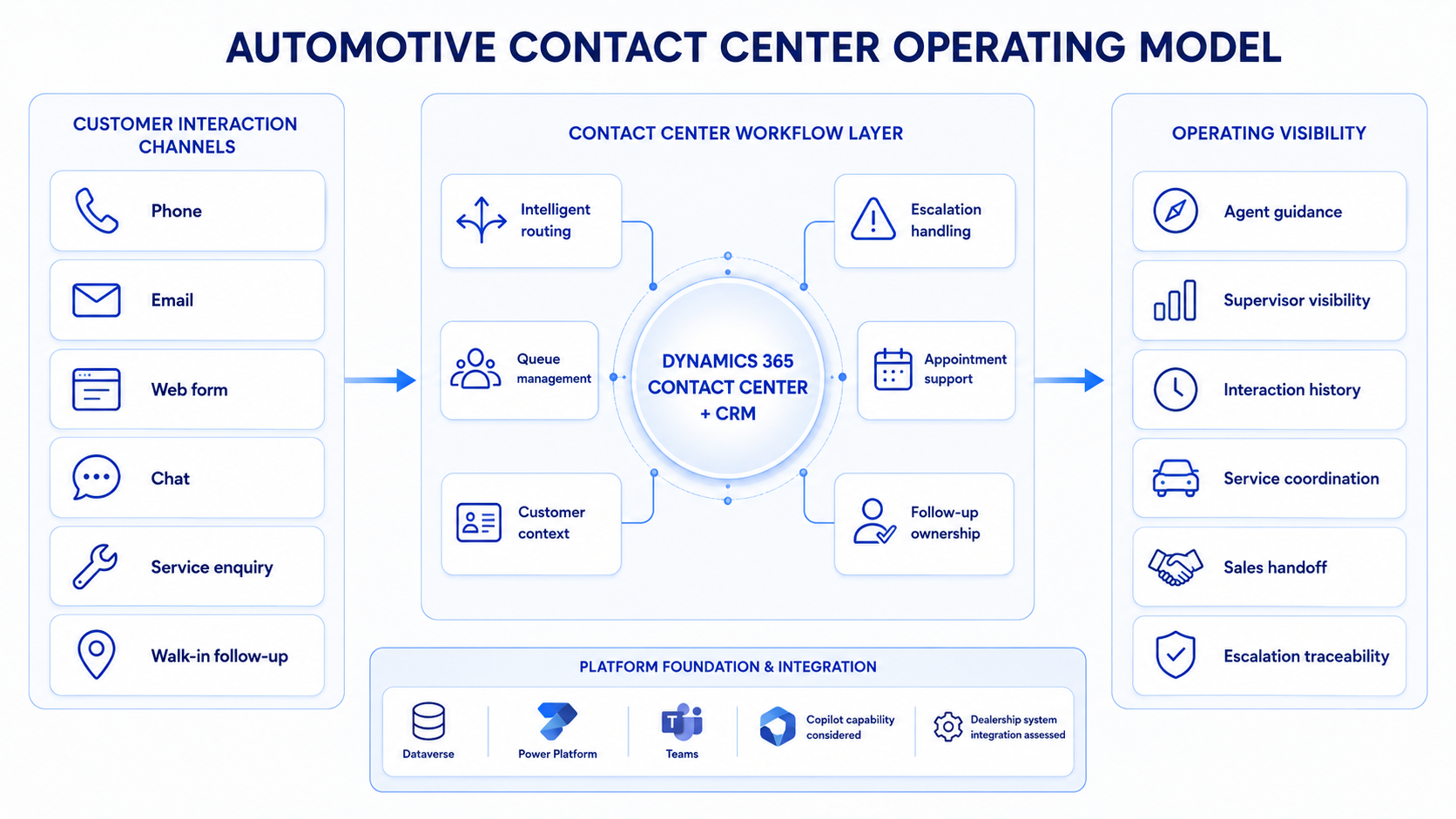
Proteance acted as a strategic review, process design, and capability mapping partner.
The role was to translate dealership Contact Center requirements into a Microsoft-aligned solution view. Proteance reviewed business needs, mapped them to Dynamics 365 Contact Center and CRM capabilities, considered the role of Dataverse and Power Platform, and modelled workflow concepts that reflected automotive retail operations.
Proteance also helped frame the Contact Center as part of a wider operating model. The emphasis was on how agents, supervisors, sales teams, service teams, and managers could work from more consistent customer and operational context.
Copilot was considered only as part of future-state capability mapping and agent guidance design. The work does not imply broad Copilot operational use.
Proteance delivered a structured view of how automotive Contact Center needs could align with Microsoft-native capabilities.
The work considered areas including omnichannel interaction handling, agent access to customer context, CRM-linked case or interaction history, routing and escalation logic, supervisor visibility, Teams collaboration, Copilot capability consideration, workflow automation through Power Platform, Dataverse as a shared data foundation, and integration points with dealership or legacy systems.
This mapping helped separate platform fit from implementation detail. It clarified which needs could align to Dynamics 365 Contact Center and CRM capabilities, which areas would require configuration, and which areas depended on process definition, data modelling, integration, or later implementation planning.
Proteance also modelled practical workflow scenarios, including appointment confirmation, service update requests, customer escalation, and test drive scheduling. These scenarios were useful because they are recognizable in automotive retail and require more than a call record. They require customer context, operational status, ownership, routing, follow-up logic, and a link between Contact Center activity and dealership process.
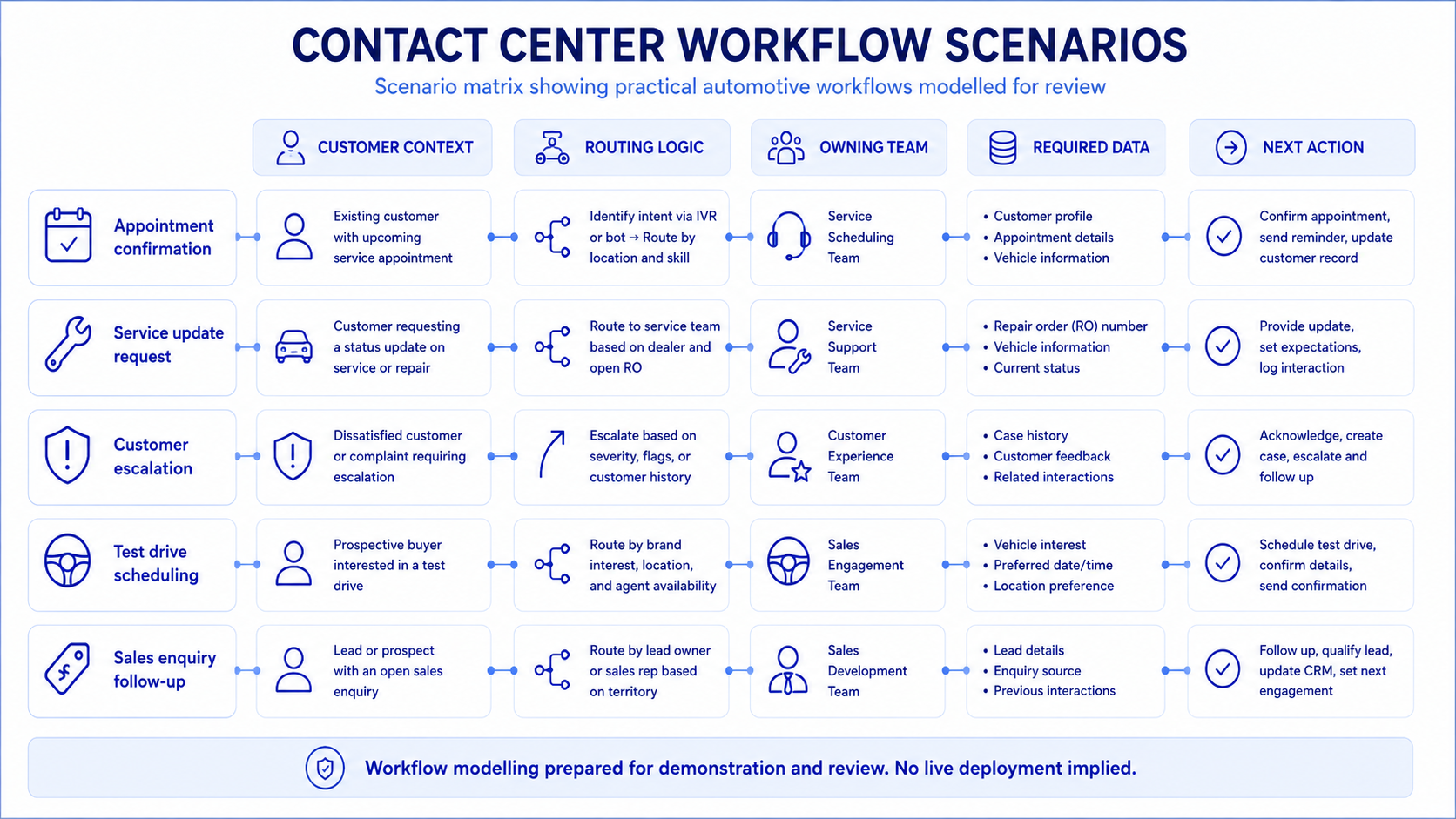
The workflow modelling made the operating dependencies visible.
It showed that successful Contact Center modernization depends on more than omnichannel handling. It depends on whether agents can see the right customer context, whether CRM and operational data are connected, whether escalation ownership is clear, and whether managers can understand what is happening across interaction types.
It also showed where implementation planning would need to focus. Future delivery would need to address which data was available, which processes needed to be standardized, which integrations were required, and which workflows could be supported natively, configured, automated, or deferred.
Most importantly, the modelling helped separate platform potential from delivery claims. It showed what could be designed, mapped, structured, modelled, and configured for demonstration without implying broader operational use.
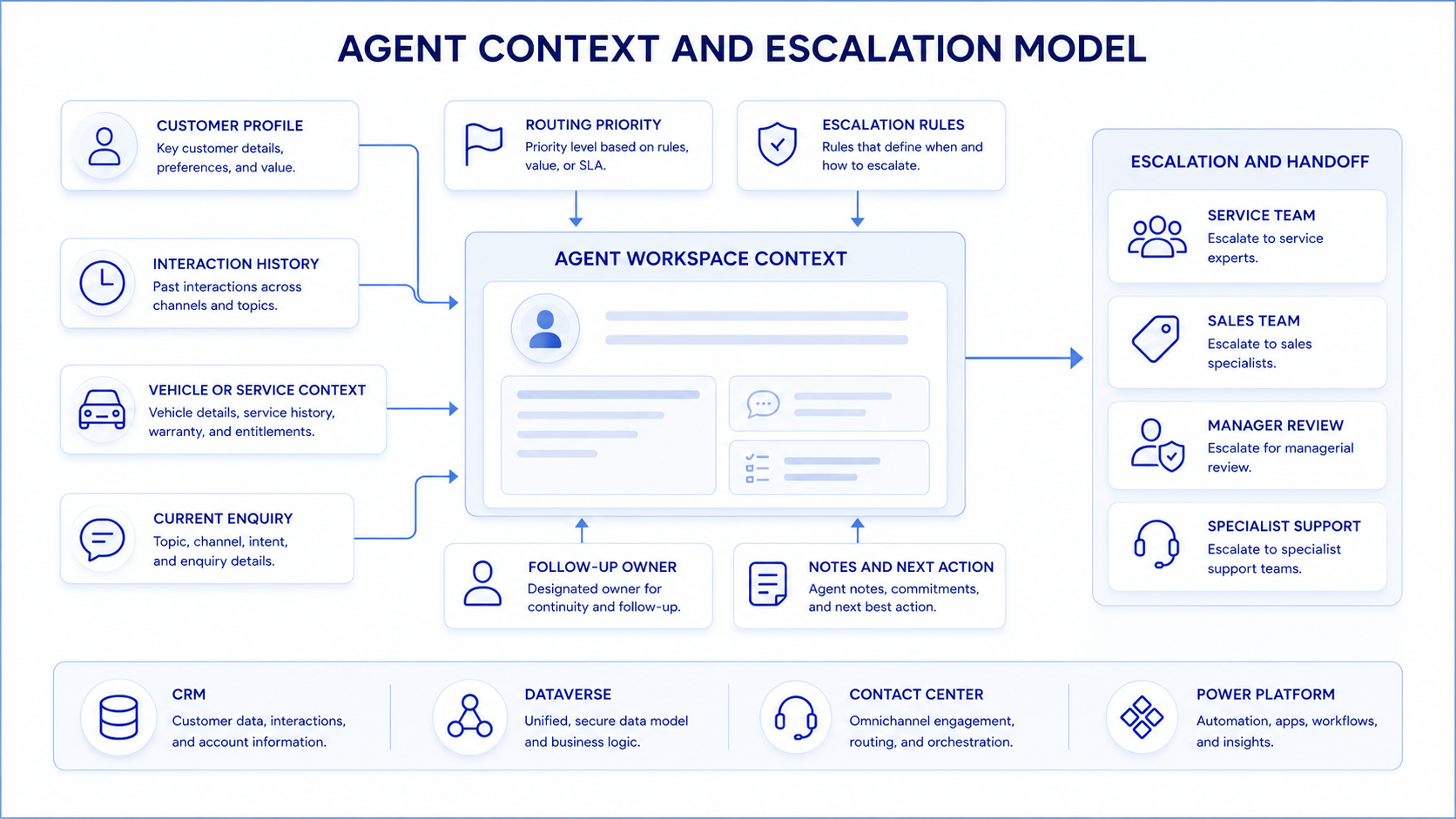
Many automotive groups rely on Contact Centers to coordinate sales enquiries, service interactions, appointments, test drives, customer follow-up, escalations, and cross-department communication.
Where Contact Center activity is disconnected from CRM or operational data, agents may lack context and managers may lack visibility. Where workflows are not clearly modelled, teams may depend on informal handoffs and local knowledge. Where integrations are assumed rather than designed, implementation risk increases.
This case demonstrates the value of starting Contact Center modernization with operating model clarity. Channels, routing, and automation matter, but they depend on trusted data, CRM integration, clear ownership, and a realistic understanding of how dealership teams work.