Client type
Major automotive retail group
Case Study
How Proteance helped a major automotive retail group structure a practical Dynamics 365 modernization path across customer engagement, operations, and data.
Proteance worked with a major automotive retail group to review a fragmented customer engagement environment spanning CRM, Contact Center, sales, aftersales, dealership operations, and legacy systems.
The engagement focused on how Dynamics 365 CRM, Dynamics 365 Contact Center, Dataverse, Power Platform, and Microsoft Cloud services could support a more coherent operating model. Proteance combined strategic review, process design, roadmap thinking, and a functioning configured system prepared for demonstration and review.
The work helped distinguish what had been reviewed, configured, demonstrated, sequenced, and taken forward into implementation planning.
Client type
Major automotive retail group
Sector
Automotive retail
Focus areas
CRM modernization, Contact Center design, customer engagement, operational data, delivery sequencing
Technologies considered
Dynamics 365 CRM, Dynamics 365 Contact Center, Dataverse, Power Platform, Microsoft Cloud
Proteance role
Strategic review, process design, configured system demonstration, roadmap thinking
Delivery status
Functioning configured system prepared for demonstration and review. No organization-wide rollout or measured operational outcomes are claimed.
The client was a major automotive retail group operating across multiple customer-facing functions, including sales, aftersales, Contact Center activity, and dealership operations.
As with many large automotive groups, the customer engagement environment had grown around multiple systems, local processes, manual workarounds, and disconnected operational views. Customer interactions could originate from several channels and pass through different teams before resolution. Relevant information could sit across CRM tools, Contact Center systems, service processes, dealership operations, and legacy platforms.
The opportunity was broader than choosing a new CRM platform. The group needed a clearer view of how customer engagement, Contact Center activity, operational data, and frontline workflows could be brought into a more coherent Microsoft-aligned operating model.
The central challenge was fragmentation.
Sales, service, Contact Center, customer follow-up, reporting, and dealership processes each depended on different data sources and ways of working. That made it harder to create a single view of customer activity, harder to manage follow-up consistently, and harder to give frontline teams timely access to the information needed to act confidently.
In automotive retail, this matters because the customer journey rarely belongs to one department. A single customer may move between digital enquiry, Contact Center conversation, showroom visit, sales follow-up, test drive, service booking, ownership support, issue resolution, and future repurchase activity.
When those interactions are not joined up, the organization may struggle to answer practical operating questions: who last contacted the customer, what was promised, which vehicle or service event is involved, what the next action should be, which team owns the next step, and which data should be trusted.
A generic CRM implementation would not have solved this on its own. The work needed to reflect dealership behaviour, Contact Center handoffs, sales and service processes, customer context, data governance, and management visibility.
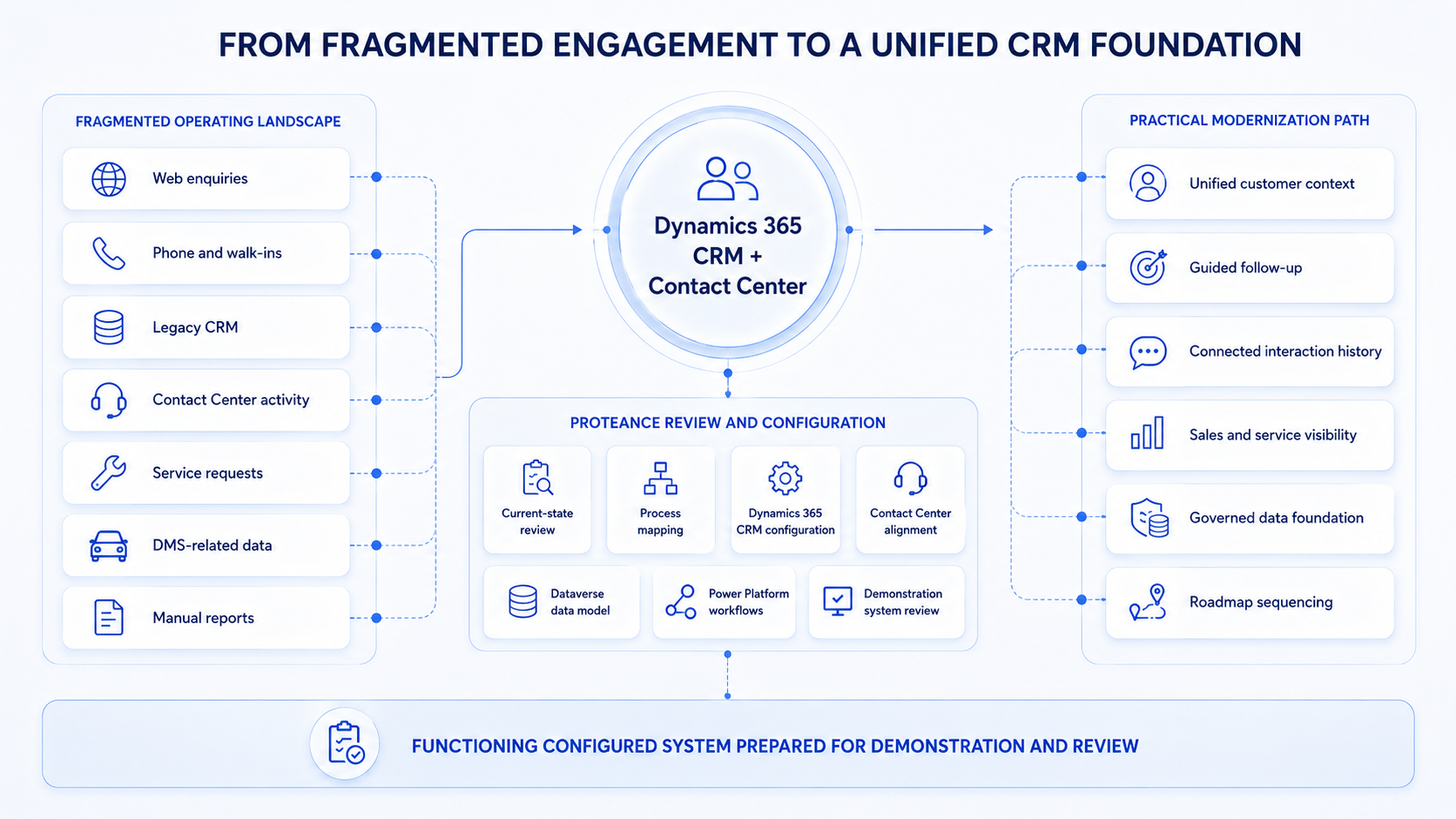
Proteance acted as a strategic review, process design, and configured system demonstration partner.
The role was to translate operational complexity into a practical modernization path. This meant reviewing the fragmented CRM, Contact Center, sales, and aftersales environment; mapping the business problems into Dynamics 365 and Power Platform solution areas; and structuring a future-state direction around Dynamics 365 CRM, Dynamics 365 Contact Center, Dataverse, Power Platform, Microsoft Cloud, and related services.
Proteance also helped distinguish between platform capability, process design, configured demonstration, and implementation planning. That distinction was important because it allowed the work to remain practical and evidence-safe, without overstating what had been delivered in broader operational use.
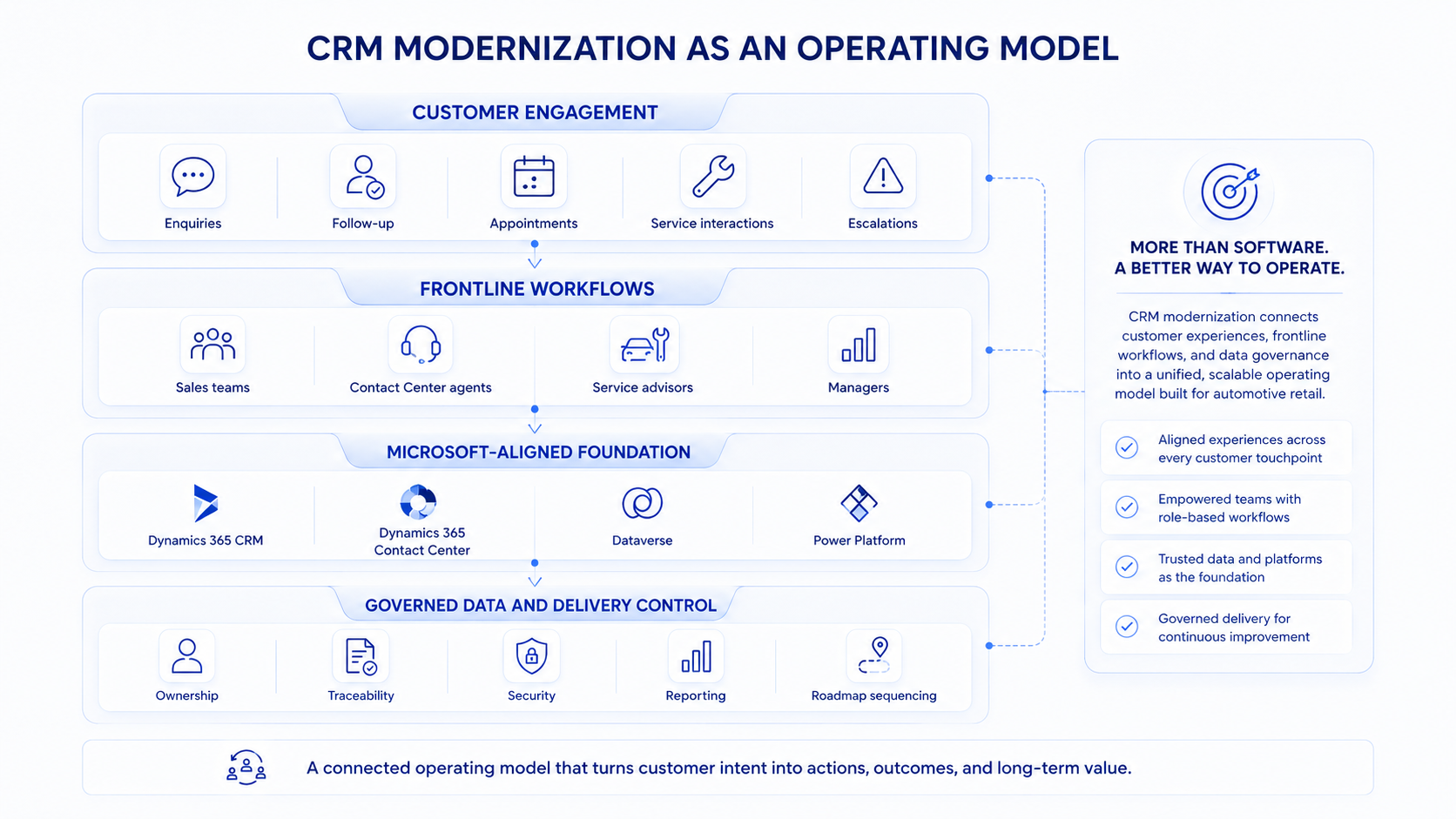
Proteance delivered a structured body of work across strategy, process design, roadmap thinking, and configured system demonstration.
The work included a review of the current operating challenge across customer engagement, sales, aftersales, CRM, and Contact Center activity. This review considered the practical problems created by disconnected systems, manual workarounds, limited visibility, and fragmented customer data.
Proteance then mapped the business challenge to Microsoft platform capabilities. This included Dynamics 365 CRM, Dynamics 365 Contact Center, Dataverse, Power Platform, and broader Microsoft Cloud services. The mapping helped separate CRM process requirements, Contact Center requirements, data and integration needs, workflow opportunities, reporting requirements, and areas requiring further validation.
A future-state direction was then designed in which CRM and Contact Center modernization formed the first layer of a broader operating model. This included thinking about unified customer and interaction views, guided workflows for frontline teams, Contact Center and CRM integration, Dataverse as a structured data foundation, Power Platform as an extension and automation layer, and roadmap sequencing from initial scope to broader maturity.
Proteance also configured a functioning demonstration system to show how Dynamics 365 CRM, Dynamics 365 Contact Center, Dataverse, Power Platform, and related workflows could support the group's specified operating needs.
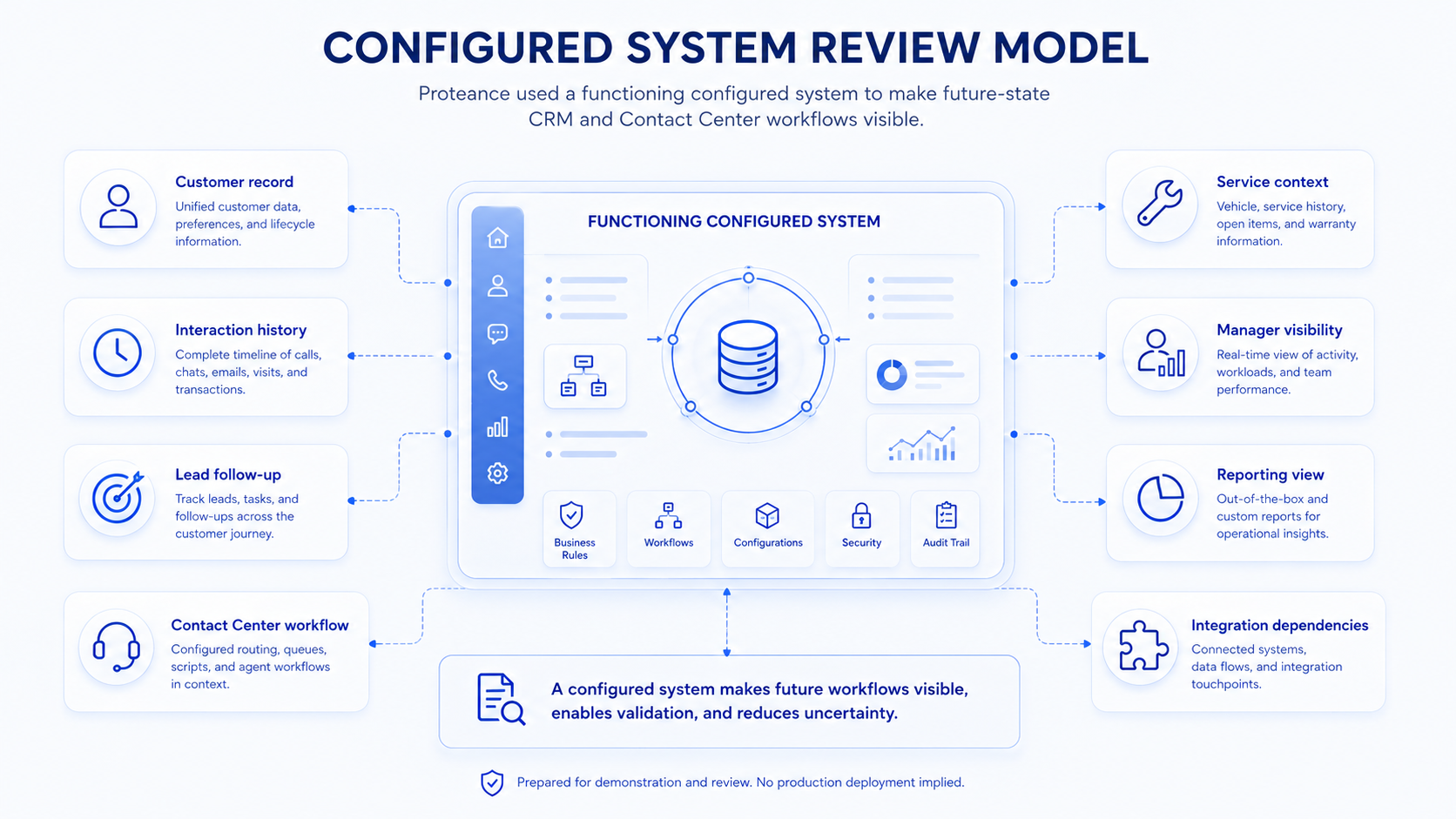
The work made several important points visible.
First, it showed that CRM modernization could not be treated as a standalone system replacement. It needed to be connected to the way sales, aftersales, Contact Center, and dealership teams actually operate.
Second, it showed that Contact Center modernization depends on more than channel handling and routing. It also depends on customer context, trusted operational data, workflow design, escalation logic, and access to the right information at the right time.
Third, it showed that a Microsoft-based platform could provide a practical foundation, but only if the requirements were structured, sequenced, and connected to real operating needs.
Finally, the work helped separate vision from delivery. It clarified what had been reviewed, what had been designed, what had been demonstrated through the configured system, and what would require further implementation planning or integration work.
Many automotive groups face similar conditions: legacy platform dependency, disconnected customer records, fragmented Contact Center processes, inconsistent follow-up, and limited management visibility across the full customer journey.
This case demonstrates the value of beginning CRM and Contact Center modernization with operating model clarity. For organizations considering Dynamics 365 CRM, Dynamics 365 Contact Center, Dataverse, Power Platform, or Microsoft Cloud, the first question is not only what the technology can do. It is how the operating model should work.
The Proteance approach is relevant where organizations need to move from broad ambition to practical delivery logic. It combines strategic review, process design, configured system demonstration, data and integration thinking, and roadmap sequencing.