Mapped a complex automotive retail system landscape across a dealer environment
Founder-Led Experience Case Study
Data Control and Customer Experience Governance
Founder-led experienceData governanceAutomotive retail
This founder-led experience involved work for a national automotive distributor seeking greater control over the customer retail experience across a distributed dealer network. The work focused on understanding how customer and operational data moved between dealers, systems, vendors, and the distributor. It combined system mapping, process review, data flow analysis, and agreement dependency review to create a clearer basis for future data sharing and governance decisions.
Traced customer and operational data handoffs between systems, vendors, and business processes
Connected data movement to the agreements and commercial arrangements governing its use
Story Overview
Story Overview
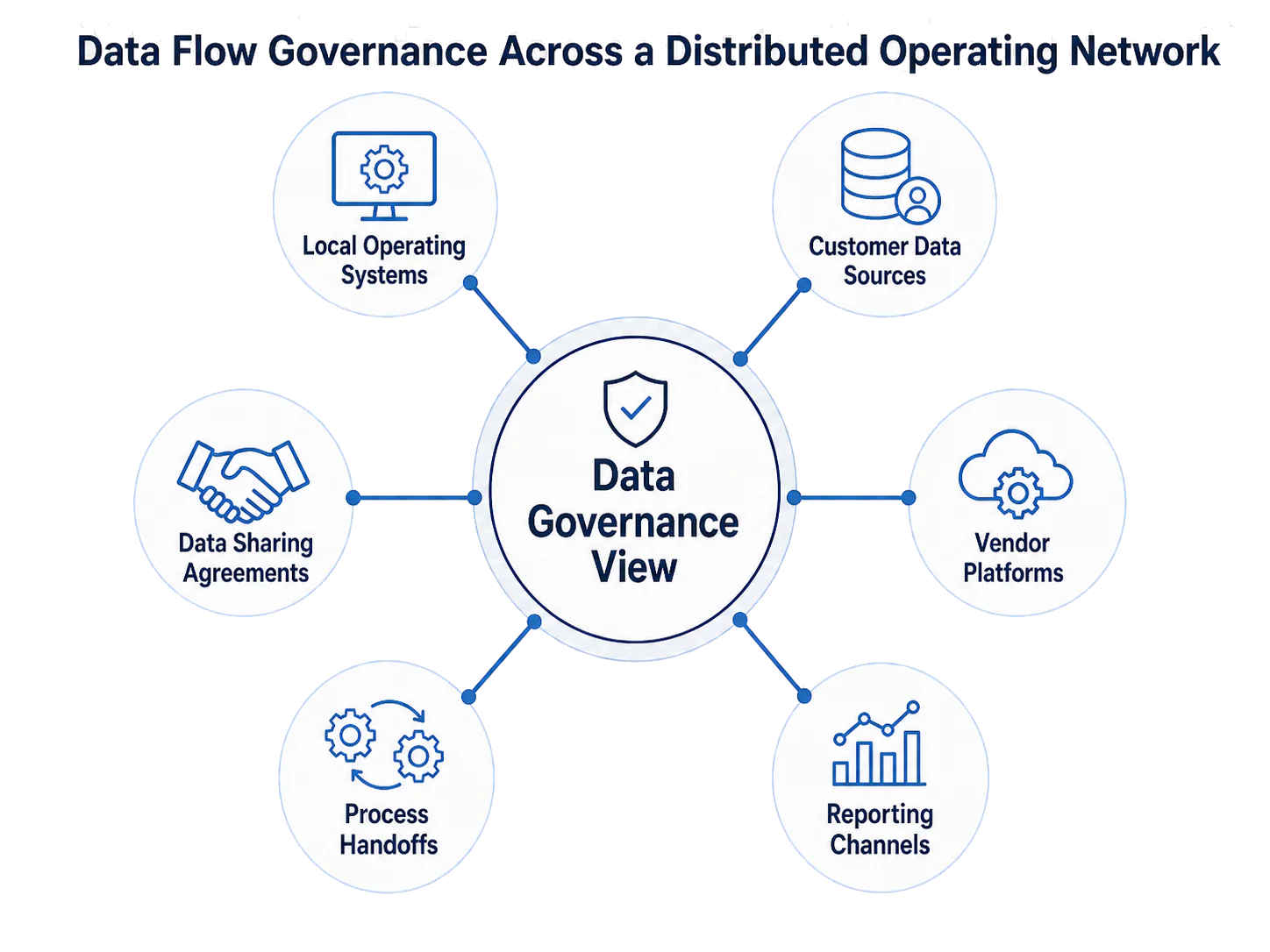
Automotive customer experience is not controlled by one system or one process. It is shaped by the way customer and operational data moves across a network of dealers, vendors, platforms, internal teams, and external service providers.
This founder-led experience focused on making that environment visible.
The organisation wanted to better understand and influence the customer-to-brand relationship across the retail journey. To do that properly, it needed more than a high-level system list. It needed a practical map of the dealer system environment, the processes those systems supported, the data moving between them, and the agreements governing each handoff.
The work provided a clearer view of how the operating model actually functioned. That clarity helped support better conversations around data control, customer experience governance, vendor involvement, and future data sharing arrangements.
Background
The Background
The operating environment was a national automotive retail network. Dealers used a range of systems to support customer management, sales, service, finance, reporting, and operational administration.
Customer data did not sit in one place. It moved through dealer systems, vendor tools, distributor systems, reporting channels, and process handoffs. Some flows were structured. Others depended on local processes, manual work, or vendor-specific arrangements.
The business objective was linked to customer experience control. The distributor needed to understand how the customer relationship was supported in practice, where data was created, which parties handled it, and how existing agreements reflected the reality of the operating model.
This was not simply a technology question. It was a business, governance, and operating model question.
Challenge
The Challenge
The main challenge was visibility.
In a distributed dealer environment, data can move through many systems before it is used to support a customer interaction or management decision. Each system may have its own purpose, vendor relationship, integration method, user process, reporting function, and contractual basis.
Without detailed mapping, it can be difficult to answer basic but important questions.
Who receives customer data? What data do they receive? Why do they receive it? What system sends it? Is the transfer automated or manual? Does the agreement reflect the actual data flow? Does the vendor have the right to use, analyse, store, or redistribute the data? Is the data movement necessary for the process, or simply inherited from a previous operating model?
These questions matter because future data sharing agreements cannot be built on assumptions. They need to be grounded in how the network actually operates.
The environment also involved practical adoption considerations. Dealers had established systems and processes. Vendors provided useful operational capabilities. Internal teams needed reporting and visibility. Any future governance model had to recognise these operational realities rather than treating them as abstract design issues.
Solution
The Solution
The experience involved a structured review of the dealer system and data environment.
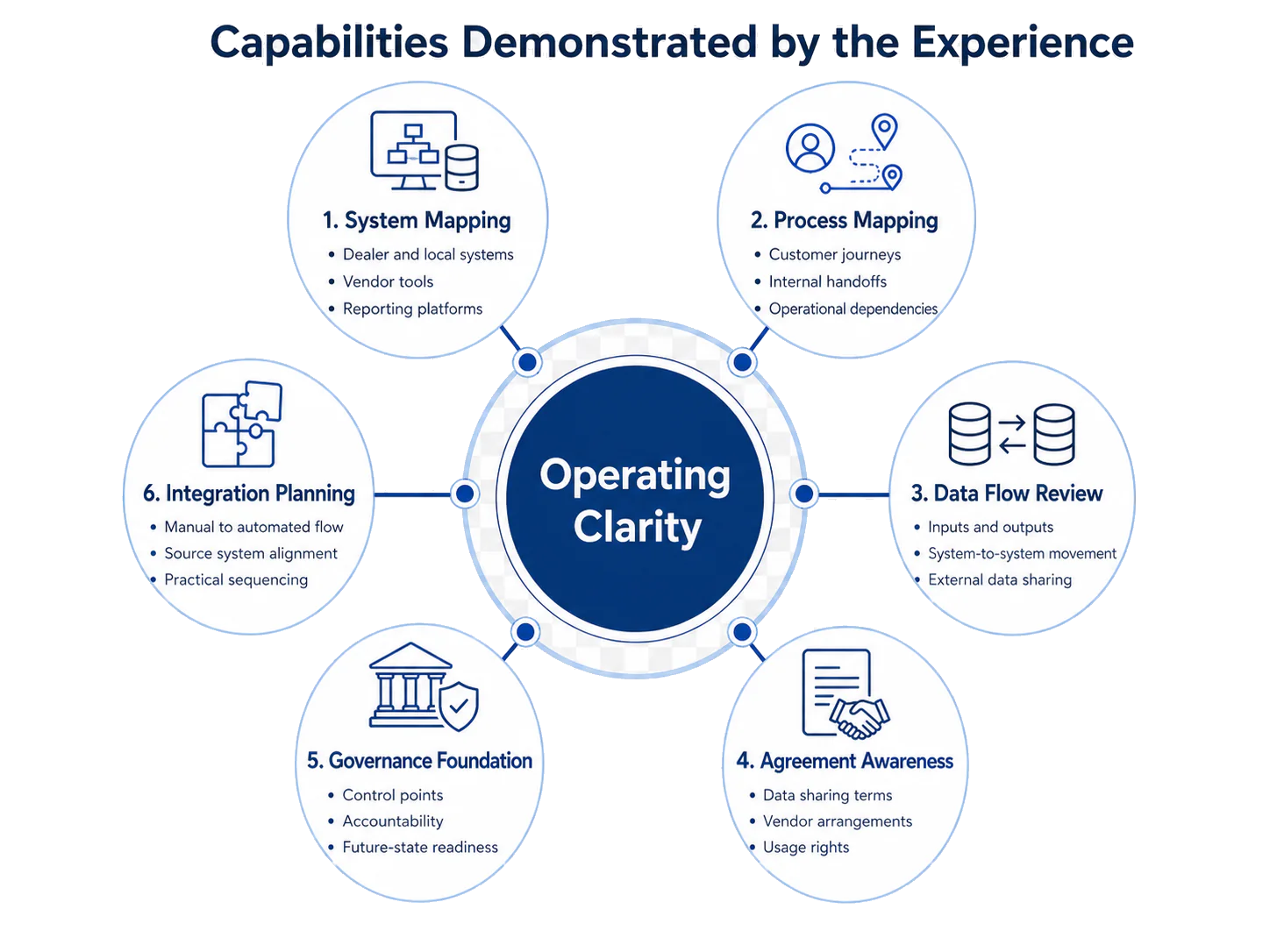
The solution pattern centred on connecting four things that are often reviewed separately: systems, processes, data flows, and agreements.
The work included mapping the systems in use at dealer level, documenting the business processes those systems supported, and tracing the movement of data through key process areas. Particular attention was given to the points where data left one system and entered another, or where it moved from one organisation to another.
At each handoff, the review considered the relevant agreement context. This included data sharing agreements, data licensing terms, vendor agreements, and other commercial or legal arrangements that helped define who could do what with the data.
The value came from connecting the operating model, not simply digitising a task.
A system map showed the technology environment. A process map showed how work actually moved. A data flow map showed what information passed between parties. The agreement review showed the rights, obligations, and dependencies sitting behind those flows.
Together, these views created a practical evidence base for stronger customer experience governance and future data sharing decisions.
Impact
The Impact
The work helped move discussion from assumption to evidence.
It created clearer visibility into the retail data ecosystem and helped identify how customer and operational data moved across systems, dealers, vendors, and distributor processes.
It also helped separate different types of issues. Some were technical integration questions. Some were process questions. Some were vendor dependency questions. Others were governance, commercial, or agreement questions.
That distinction mattered. Not every data control issue is solved by a new system. Not every integration issue is solved by a new agreement. Effective governance depends on understanding the relationship between the two.
The experience also reinforced the importance of document discipline and operational visibility. Data sharing agreements need to reflect how data moves in practice. Business leaders need enough visibility to understand where control exists, where it is shared, and where it may be limited by existing vendor or process arrangements.
The result was a stronger foundation for future data sharing, reporting, governance, and customer experience control.
Why It Matters
Why This Matters for Data-Led Platforms
Many organisations now want to create data-led platforms that connect participants, systems, vendors, and external users. These platforms often promise better visibility, stronger control, improved reporting, and more efficient workflows.
The risk is that future-state design can move too quickly past current-state reality.
A reliable data platform depends on trusted data, clear source systems, known handoffs, defined access rights, and practical operating processes. It also depends on the confidence of the people and organisations expected to participate.
That is especially important where data moves between independent parties. Centralised control may be needed, but local ownership and operational autonomy may still matter. External access may be useful, but it needs to be governed. Automated integration may be the goal, but manual upload, staged pilots, and transitional operating models may be necessary steps.
This founder-led experience is relevant because it dealt with those realities in a practical automotive environment.
It shows the importance of mapping before redesigning. It also shows why data normalisation, secure data distribution, controlled third-party access, auditability, and reporting cannot be treated as isolated technical features. They need to be designed around how the business actually works.
Availability and performance are business requirements, not just technical considerations. So are trust, clarity, and adoption.
Proteance Lens
How This Experience Informs Proteance
This founder-led experience now informs how Proteance approaches secure digital platforms, data exchange models, integration strategies, and operational workflow solutions.
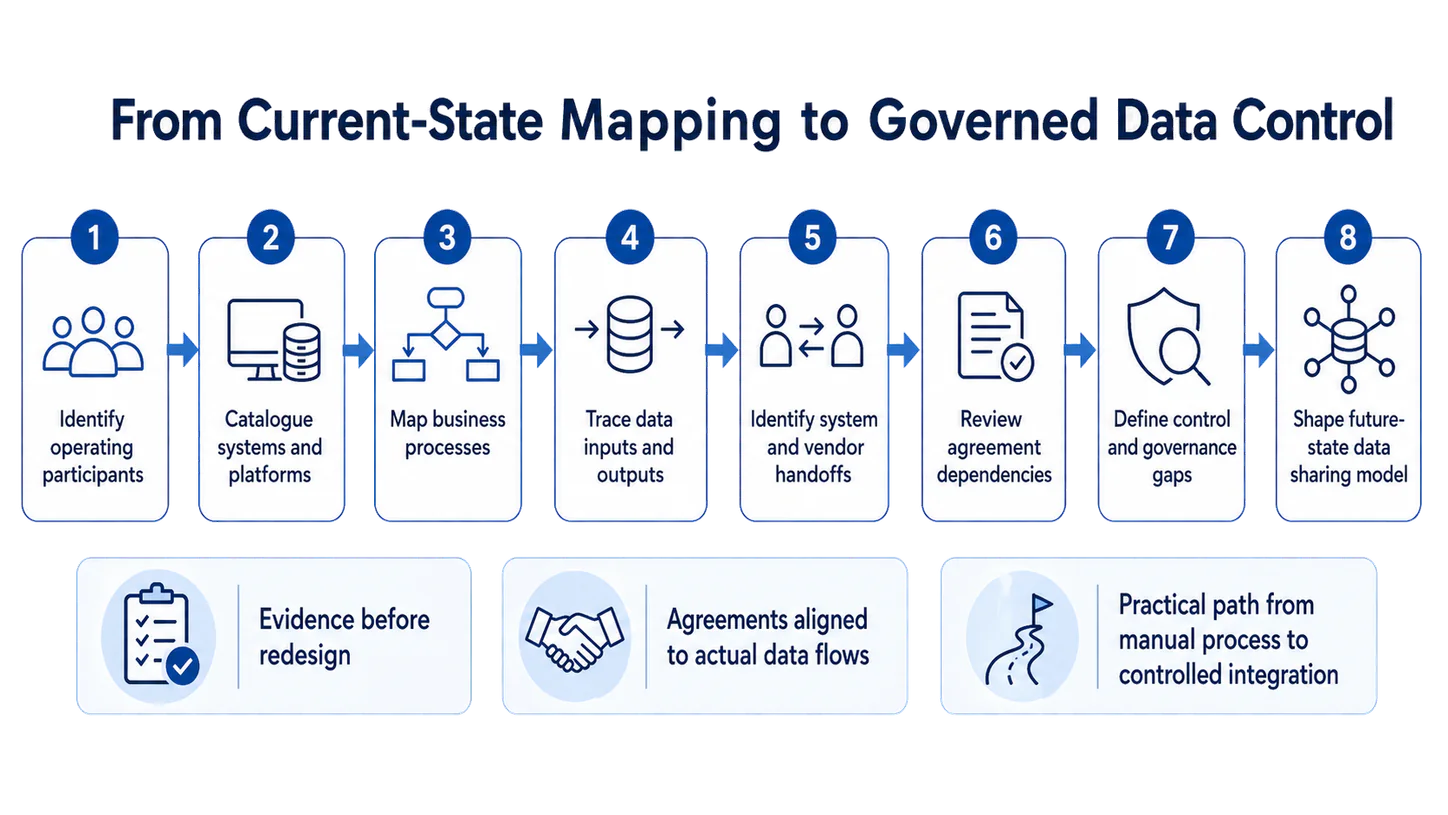
Proteance's approach starts with understanding the operating environment before proposing the platform. That means identifying the systems already in use, the processes that depend on them, the data moving through them, the parties receiving that data, and the governance or agreement structure sitting behind the flow.
This is directly relevant to organisations considering participant-facing portals, customer-facing platforms, governed data access, operational reporting, or integration with external systems.
The experience supports a practical delivery approach: start with evidence, define the operating model, design for control, pilot carefully, and then move towards more automated integration where the business case and adoption path are clear.
Proteance brings this perspective to platform design, workflow automation, reporting, data handling, secure access, and pilot-to-production planning.
Strong data governance starts with understanding the real operating environment, not the idealised version shown in a system diagram.
What this experience demonstrates
- Current-state system and process mapping
- Data flow and handoff analysis
- Data sharing and licensing agreement awareness
- Vendor dependency review
- Customer experience governance
- Secure platform and integration thinking
- Operational reporting and visibility
- Practical pilot-to-production planning
Explore related Proteance areas
Planning a data platform or governed integration model?
If your organisation is planning a data platform, integration programme, or governed data sharing model, Proteance can help you understand the current state before committing to the future state.
Disclaimer
This case study reflects founder-led experience that now informs Proteance's approach. It is presented to illustrate relevant platform, workflow, data, operational, and integration experience.