National dealer network
Digital retail journey built across a Canadian authorized dealer network with multiple data channels and customer touchpoints.
Founder-Led Experience Case Study
From fragmented vehicle listings to centralized inventory, secure reservation, and continuous customer journey improvement.
National dealer network
Digital retail journey built across a Canadian authorized dealer network with multiple data channels and customer touchpoints.
Source-of-truth inventory
Manufacturer's global vehicle systems used as the authoritative base for listings, specifications, availability, and status.
Secure online reservation
Deposit capture, secure payment processing, dealer notification, and vehicle status control across a governed digital workflow.
Data-driven improvement
Web traffic, customer interviews, dealer feedback, and operational evidence used as a continuous improvement operating rhythm.
Executive Summary
A Canadian importer and distributor for a major German luxury sports car manufacturer set out to create a more seamless digital retail journey across its authorized Canadian dealer network.
The work began with a practical but important problem: online vehicle listings were inconsistent, difficult to control, and not always reliable. Dealer websites, dealer group sites, the manufacturer's Canadian website, third-party listing platforms, local dealer systems, website vendors, and global manufacturer systems were all involved in the customer-facing inventory experience.
Customers were increasingly moving from showroom-first discovery to online-first research. They expected to search available vehicles, compare options, understand pricing, and take meaningful action online. However, the underlying operating model had not been designed as one connected journey.
The project evolved from improving vehicle listing accuracy into a broader digital retail transformation. It established a more controlled source-of-truth model for vehicle inventory, supported a centrally managed dealer website network, extended the online journey to allow customers to place deposits to reserve vehicles, and introduced a continuous improvement model based on web traffic, customer behaviour, dealer feedback, and real-world customer interviews.
The result was a stronger foundation for a manufacturer-controlled digital retail experience in Canada.
Situation
The traditional vehicle purchase journey was centred around the physical dealership. Customers visited a retailer, spoke with a sales consultant, reviewed available vehicles, and continued the buying journey in person.
That behaviour was changing. Customers were beginning their journey online and expected the digital experience to reflect the same level of confidence, accuracy, and brand quality they associated with the physical retail experience.
The Canadian market included multiple digital touchpoints spanning dealer websites, the manufacturer's Canadian website, dealer group websites, third-party marketplaces, dealer sales and inventory systems, global manufacturer vehicle and inventory systems, and website or integration vendors.
From the customer's point of view, these appeared to be part of one brand experience. Operationally, they were not always governed as one system.
Business Problem
The initial problem appeared as inaccurate online inventory.
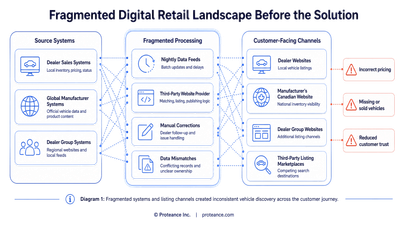
Dealer websites had historically been operated by a third-party provider. Vehicle listings were generated through a complex process involving nightly data feeds from individual dealer sales systems, combined with official vehicle information from the global manufacturer.
This structure created frequent mismatches between locally held dealer data and official manufacturer data.
Common issues included incorrect pricing, missing vehicles, sold vehicles remaining online, inconsistent specifications, overnight feed delays, limited visibility into error sources, unclear correction ownership, and inconsistent customer experiences across dealer and national channels.
This created risk at a critical point in the customer journey. A customer searching online could see a vehicle that was no longer available, miss a vehicle that was available, or encounter pricing and specification details that did not match official records.
The deeper issue was not simply website content. It was fragmented data ownership.
Strategic Challenge
The project had to solve more than a website problem.
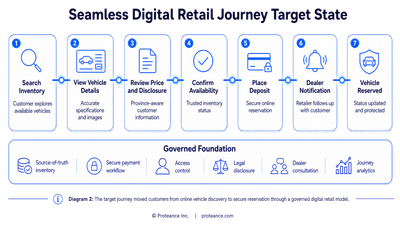
The intended journey was broader:
Search available vehicles → review accurate details and disclosure → trust availability → place a secure online deposit → notify dealer and update manufacturer status → protect reservation → continue purchase journey with the dealer.
Coordination was needed across inventory governance, dealer website management, national vehicle search, pricing disclosure, payment processing, secure cloud infrastructure, access management, dealer notification, manufacturer updates, customer research, dealer consultation, legal review, security testing, penetration testing, web analytics, and continuous product iteration.
The work sat at the intersection of customer experience, data governance, payments, cybersecurity, legal compliance, dealer relations, and digital product management.
Solution Approach
Establish a stronger source-of-truth model
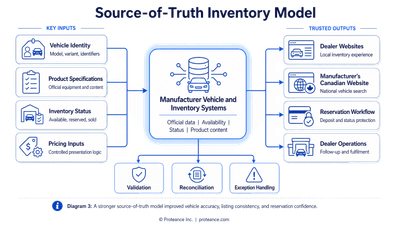
The first step was to rationalize the inventory data model.
Rather than relying on fragmented reconciliation between dealer system feeds, third-party website logic, and manufacturer data, the project moved toward using the manufacturer's global vehicle and inventory systems as the authoritative source for vehicle identity, specifications, availability, and status.
This supported greater control over key inventory quality dimensions.
This became the foundation for a more reliable online retail experience.
Move toward a centrally managed dealer website network
Dealer websites were repositioned as part of the national customer journey rather than as isolated local websites.
A centrally managed dealer website network helped improve consistency across inventory presentation, brand standards, vehicle detail pages, inquiry flows, pricing presentation, data quality controls, customer journey design, and dealer participation.
The objective was to make the official manufacturer ecosystem the most reliable place for customers in Canada to search for available vehicles.
Extend the journey into online reservation
Once online inventory was more controlled, the journey could move from browsing to action.
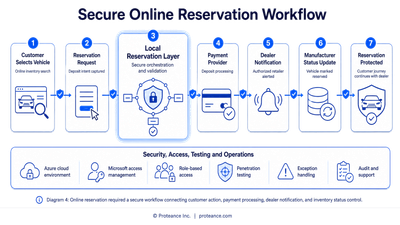
The goal was to allow a customer to place a deposit online to reserve a specific vehicle. The manufacturer's existing systems were not ready to support the full online payment mechanism directly, so a local systems provider was engaged to extend the journey. The provider created a secure system layer connected to a payment provider.
The reservation workflow had to include customer deposit capture, secure payment processing, dealer notification, manufacturer update paths, vehicle status protection, controlled user access, exception handling, and full end-to-end plus penetration testing.
Azure was used as part of the technical environment, with Microsoft tooling supporting secure access management and system administration. This transformed the website experience from a vehicle listing channel into a more active digital retail journey.
Data-Driven Product Management
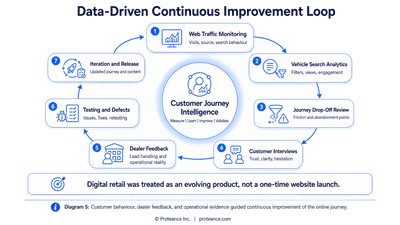
The project was managed as an evolving digital product, not as a one-time website launch. Web traffic and customer behaviour were monitored continuously. The team reviewed how customers interacted with the online experience and used that evidence to guide ongoing improvements.
The evidence base combined quantitative and qualitative signals:
Continuous loop: observe customer behaviour and operational data → diagnose friction and defects → improve the journey, content, or logic → validate impact → iterate using new evidence.
Quantitative data showed where customers were going, what they were using, and where they dropped off. Customer interviews helped explain why those behaviours occurred. Dealer consultation showed what happened operationally after the customer acted. This combination of analytics, customer research, and dealer feedback helped guide product decisions.
Customer Research and Dealer Consultation
Real-world customer interviews were used to understand what customers needed from an online vehicle search and reservation experience. Customer research helped clarify how customers searched for vehicles, what information they needed before contacting a dealer, what created trust in online vehicle availability, what created concern or hesitation, how much clarity was needed around pricing, what customers expected after placing a deposit, and how the online journey should transition into dealer follow-up.
Dealer consultation was equally important.
The project affected how dealers presented inventory, received leads, responded to reservations, and participated in a national digital retail model.
There was also a natural dealer concern around national inventory visibility. The manufacturer's Canadian website allowed customers to search vehicles across Canada, which meant a local customer could discover and reserve a vehicle from another dealer.
The project therefore required careful balancing of customer choice, dealer territory sensitivities, national brand consistency, inventory transparency, dealer operational readiness, and long-term channel strategy.
Guiding principle
Customers searching for a vehicle in Canada should have the strongest, clearest, and most trusted experience within the manufacturer's own ecosystem.
Legal and Pricing Disclosure
The online journey also required extensive legal work.
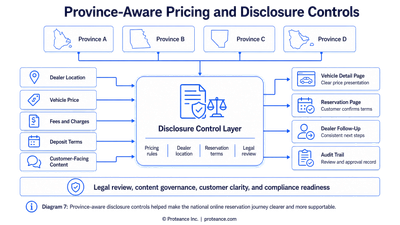
Vehicle pricing disclosure requirements varied across Canadian provinces. A national digital retail experience could not rely on one generic pricing presentation for every customer, dealer, and province.
The solution needed to account for:
This was especially important because the journey was not merely promotional. It supported a commercial action: placing a deposit to reserve a vehicle. A trusted digital retail experience required pricing transparency, compliant disclosure, and clear customer communication.
Security, Access, and Testing
Online reservation introduced a higher standard for security, control, and testing. The solution involved a local systems provider, payment processing, cloud infrastructure, access management, dealer notification, and manufacturer system updates.
Security and testing covered secure payment flow design, controlled user access, dealer notification controls, system-to-system communication, vehicle status logic, reservation-event protection, end-to-end validation, penetration testing, issue management, and remediation retesting.
Testing was not limited to whether a customer could submit a deposit. The full business workflow had to be validated:
Customer selects vehicle → customer places deposit → payment processes securely → dealer is notified → vehicle status updates → reservation is protected → access rights enforced → exceptions handled → customer journey continues cleanly.
The project treated online reservation as an operational workflow, not just a payment button.
Channel Governance
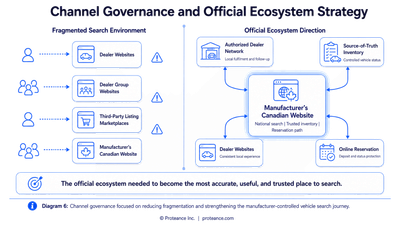
A major strategic challenge was channel fragmentation. Vehicles were visible across dealer websites, the national manufacturer website, dealer group websites, and third-party marketplaces.
The long-term objective was to strengthen the manufacturer's own ecosystem so that customers searching for vehicles in Canada would use the official channel as the trusted destination.
This required more than asking dealers to change behaviour. The official ecosystem needed to be more accurate, complete, useful, and commercially effective than the alternatives.
Strategic direction
If a customer in Canada is searching for one of the manufacturer's vehicles, the official manufacturer ecosystem should be the most reliable place to search, compare, inquire, and reserve.
This created a practical objective: reduce reliance on fragmented third-party listings, concentrate new vehicle listings in the official ecosystem, build toward stronger control of used listings, reinforce the national site as the trusted destination, and preserve dealer engagement while improving customer transparency.
Transformation
The work helped move the Canadian retail environment from fragmented online listings toward a more governed digital retail journey.
The value was not simply a better website. It was a stronger operating model for managing the digital customer journey across a national dealer network.
Why This Matters
A customer does not separate the website from the brand.
If a website shows the wrong vehicle, the wrong price, an unavailable listing, or unclear reservation terms, the customer experiences that as a brand failure.
Automotive digital retail therefore depends on more than attractive design. It requires:
This experience demonstrates why digital retail systems should be treated as governed operating models rather than standalone websites.
Lessons Carried into Proteance
Closing Statement
This founder-led experience shows how a vehicle website project can become a broader digital retail transformation. The work began with inaccurate inventory listings and fragmented dealer website data. It expanded into a more controlled national customer journey involving centralized inventory, dealer website governance, online reservation, secure payment integration, access management, legal disclosure, customer research, dealer consultation, analytics, and continuous improvement.
The practical lesson now carried into Proteance is that automotive digital retail cannot be solved through front-end design alone. It requires trusted data, governed integration, secure workflows, dealer alignment, customer feedback, and the discipline to keep improving based on real usage. Proteance applies this operating philosophy to help automotive organizations move from fragmented digital processes toward controlled, data-driven, and customer-aware workflows.
Contact usDisclaimer
This case study reflects anonymized founder-led experience from work performed before Proteance was formed. It is presented to illustrate relevant automotive retail, digital customer journey, dealer network, data governance, secure integration, payment workflow, legal disclosure, and operational delivery experience. It does not disclose confidential manufacturer information and does not imply endorsement by, affiliation with, approval from, or a current commercial relationship with the manufacturer, its dealers, vendors, payment providers, or related entities.