Multi-location
Data unified across sales, service, parts, inventory, finance, and customer operations
Founder-Led Experience Case Study
Turning Fragmented Automotive Data into Governed Management Intelligence
Automotive groups usually do not struggle because they lack data. They struggle because data sits in different systems, follows inconsistent definitions, arrives at different times, and is often distributed through manual reports that are difficult to control. This founder-led experience now informs how Proteance approaches secure, governed, and practical operational intelligence for automotive organizations.
Multi-location
Data unified across sales, service, parts, inventory, finance, and customer operations
Governed
Role-based access, controlled distribution, validation, and reconciliation by design
Trusted
From raw source feeds to curated reporting tables and decision-ready management outputs
Executive Summary
A multi-location automotive retail organization needed a more dependable way to understand performance across sales, service, parts, inventory, finance, customer activity, pricing, margin, and operational throughput.
Data existed in many places, but reporting was not always consistent, timely, or easy to govern. Teams often spent time reconciling numbers before discussing action.
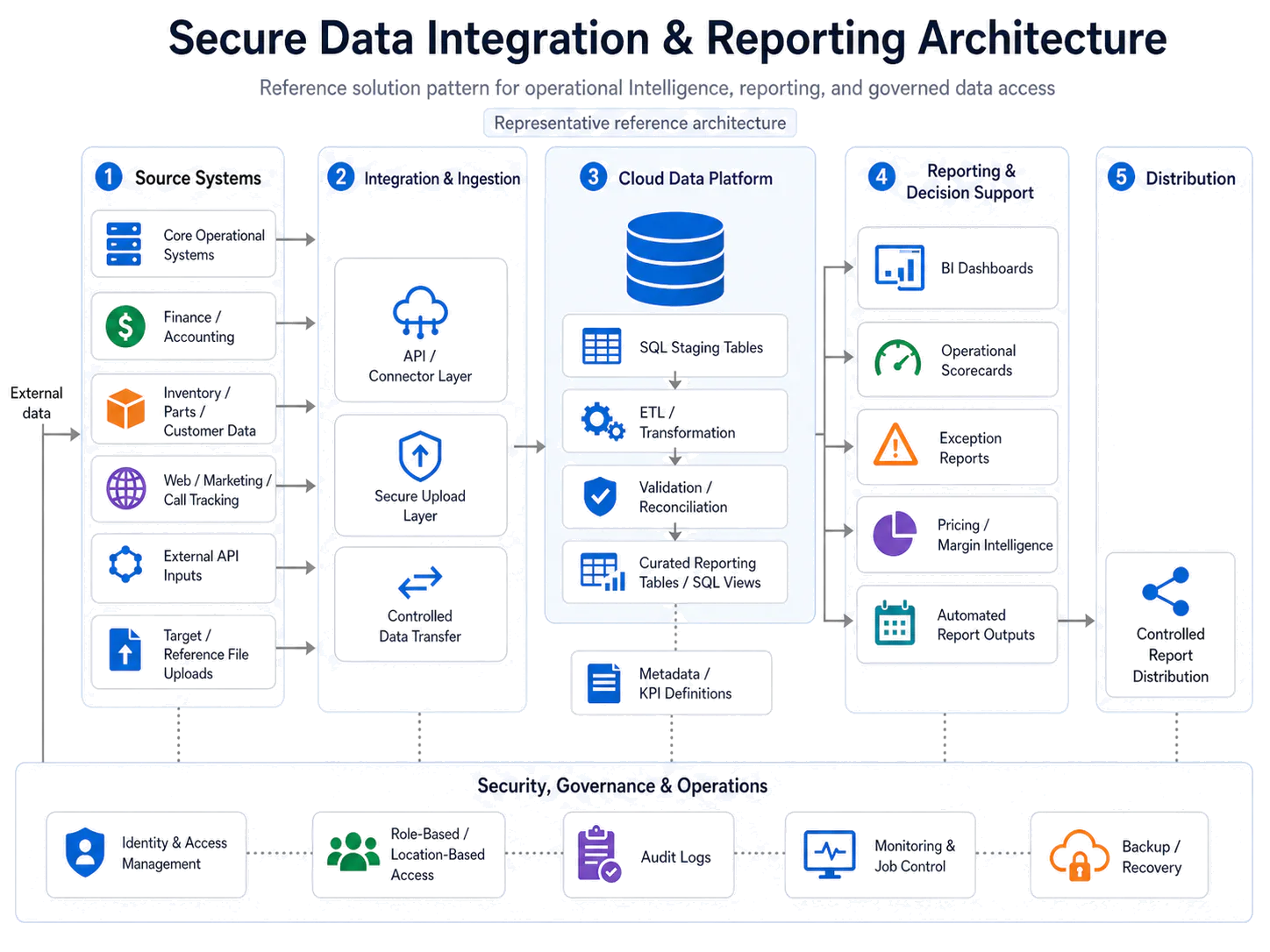
The founder-led role focused on translating business reporting needs into a secure integration and management intelligence pattern. The approach used controlled feeds, APIs and connectors, secure uploads, cloud SQL reporting, staging tables, ETL transformation, validation, reconciliation, curated reporting tables, and governed outputs.
The deeper value was not only better reporting. It was a stronger operating foundation that reduced manual effort, improved KPI consistency, surfaced exceptions earlier, protected sensitive information, and created a scalable base for future automation and AI-assisted decision support.
Founder Perspective
In automotive retail, a dashboard is the visible output, but the real issue is often underneath. Sales, service, parts, finance, inventory, customer activity, and marketing data can each tell only part of the story.
Without governed definitions and connected data flows, meetings become debates about which number is correct. Manual reporting consumes time, exceptions are harder to detect, and trust in reports declines.
This founder-led lesson informs Proteance directly: operational intelligence must be designed around how the business is actually managed, including roles, locations, departments, accountability, and commercial sensitivity.
Situation
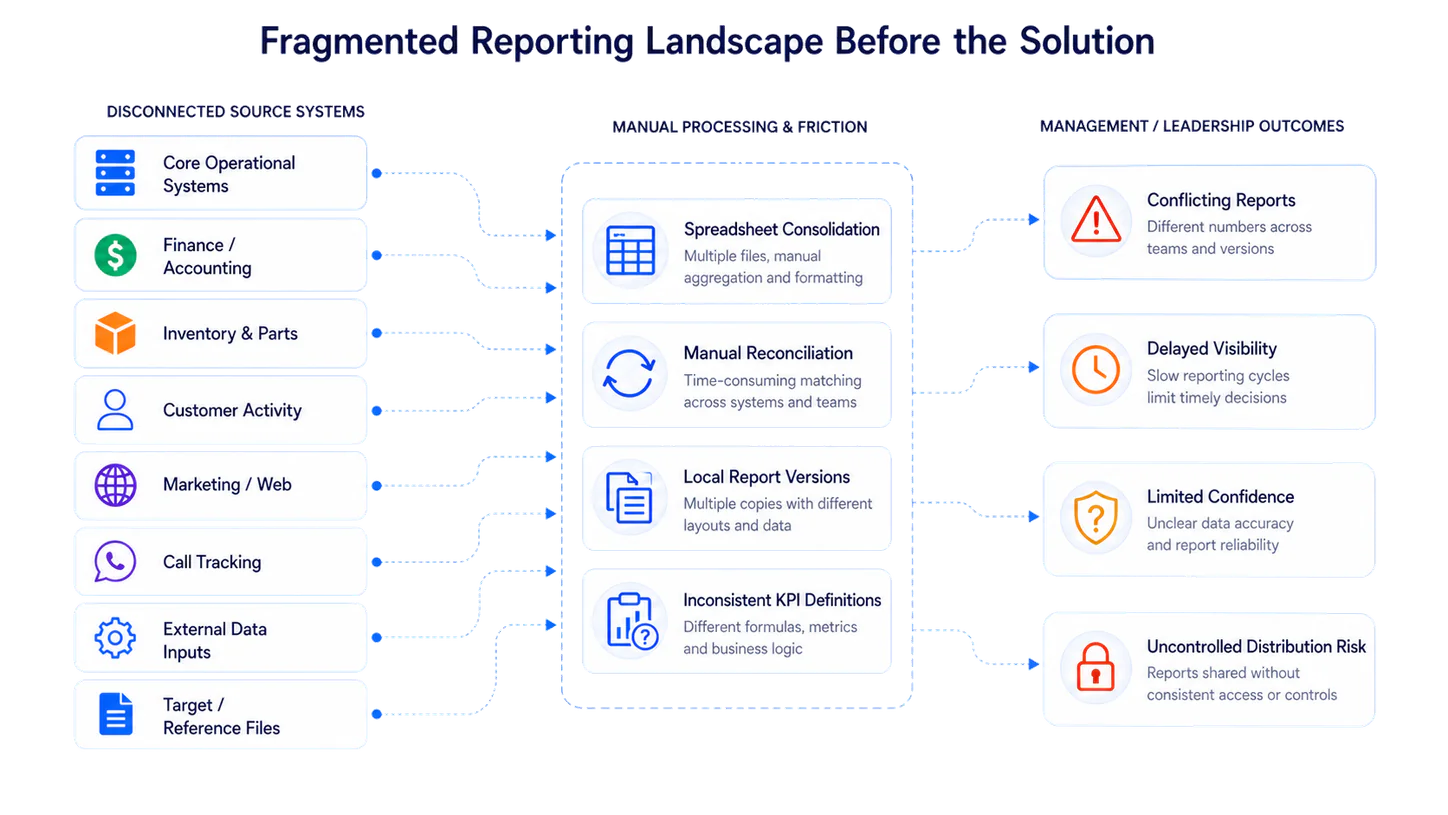
The organization operated across multiple locations with data spread across core operational systems, finance platforms, inventory and parts sources, CRM and customer activity tools, call tracking, marketing systems, web analytics, external feeds, and manually managed targets/reference files.
Leadership needed practical answers: where performance was off track, which areas required intervention, and whether managers were operating from the same trusted view of results.
The challenge was not an absence of reporting. The challenge was that reporting was not consistently joined up, governed, or trusted enough to support reliable cross-organization decision-making.
Business Problem
Five practical risks of disconnected reporting:
Pricing, margin, finance, location results, and customer-related activity all carry commercial risk when access and distribution are not governed.
Leadership needed both improved visibility and stronger control. The solution had to increase usefulness while making access secure, role-aligned, and auditable.
Founder-led Role and Contribution
The contribution spanned stakeholder discovery, reporting requirement interpretation, data mapping, architecture design, implementation support, governance design, and adoption considerations.
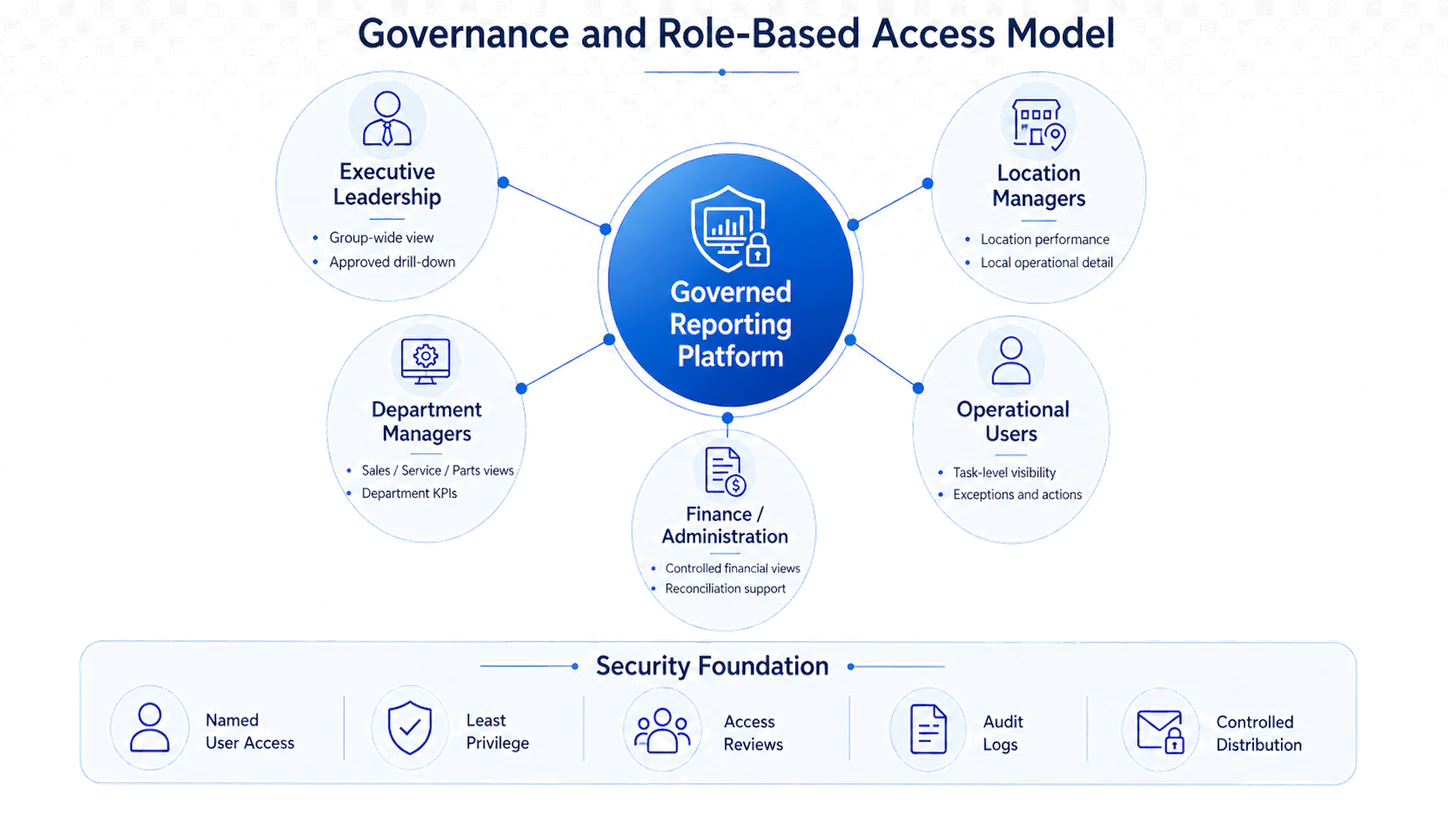
A key principle was role-aware reporting. Leadership needed broad cross-business visibility, while location and department managers needed targeted operational detail. Access boundaries had to protect sensitive information without blocking legitimate decisions.
This combined business interpretation and system design is now embedded in Proteance's operating approach.
Solution Overview
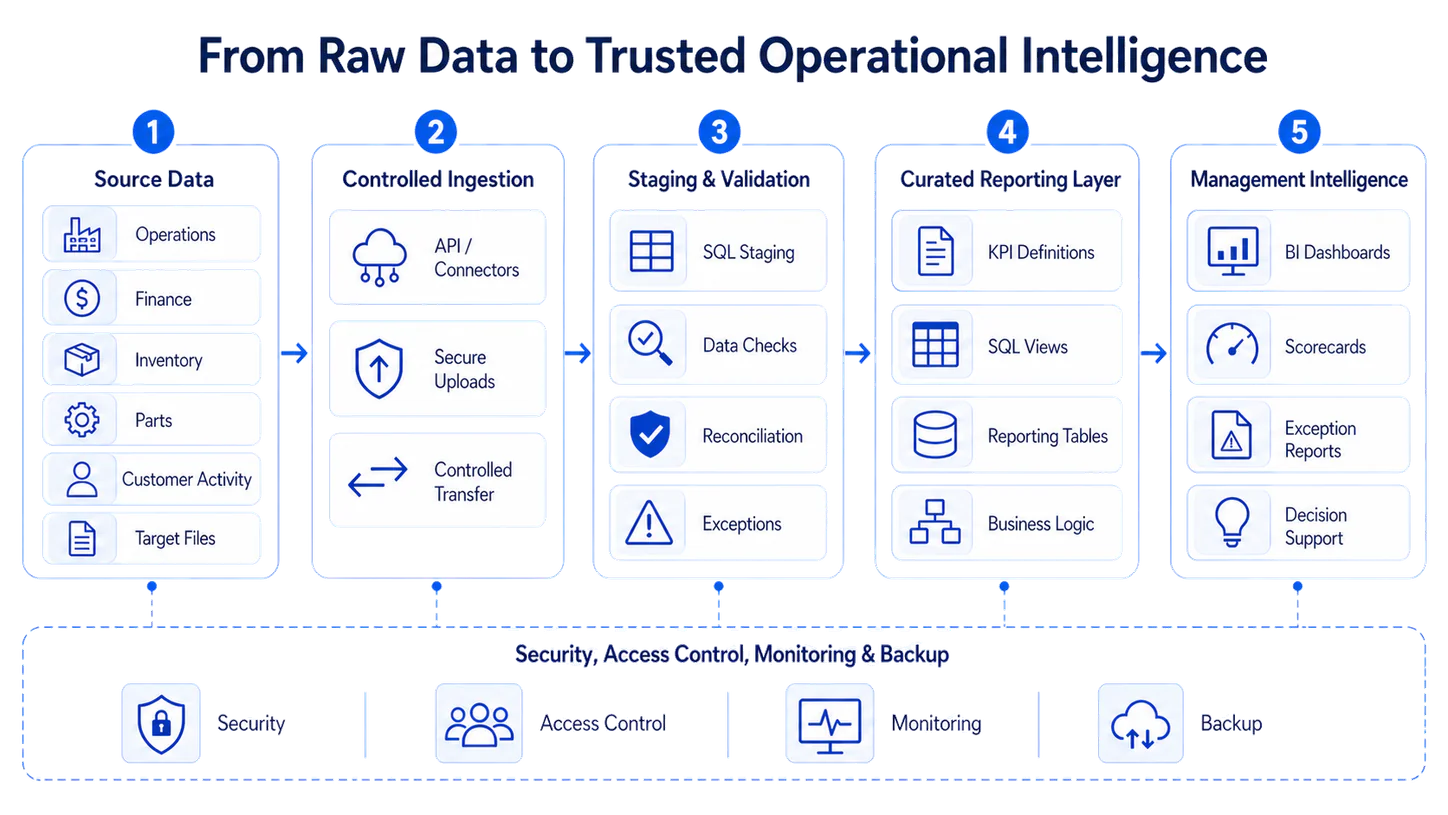
Data was extracted through controlled feeds, APIs, and connectors, then loaded into a cloud-hosted SQL reporting environment. Source data was staged first, then transformed through ETL sequencing, validation, and reconciliation.
Curated reporting tables and SQL views applied shared KPI logic so definitions were managed once and reused consistently across dashboards, scorecards, exception reports, automated outputs, and leadership packs.
This design shifted reporting away from disconnected spreadsheet logic toward governed, repeatable, and scalable management intelligence.
Security, Governance and Controlled Access
Security and governance were foundational. Access was aligned to named users, roles, locations, departments, and level of responsibility, following least-privilege principles.
Secure API credentials were treated as controlled technical assets. Report distribution controls were also important, because exported files can bypass platform protections if unmanaged.
Audit logs, monitoring, job control, backup, and recovery supported dependability and continuity of access.
Data Quality and Trust
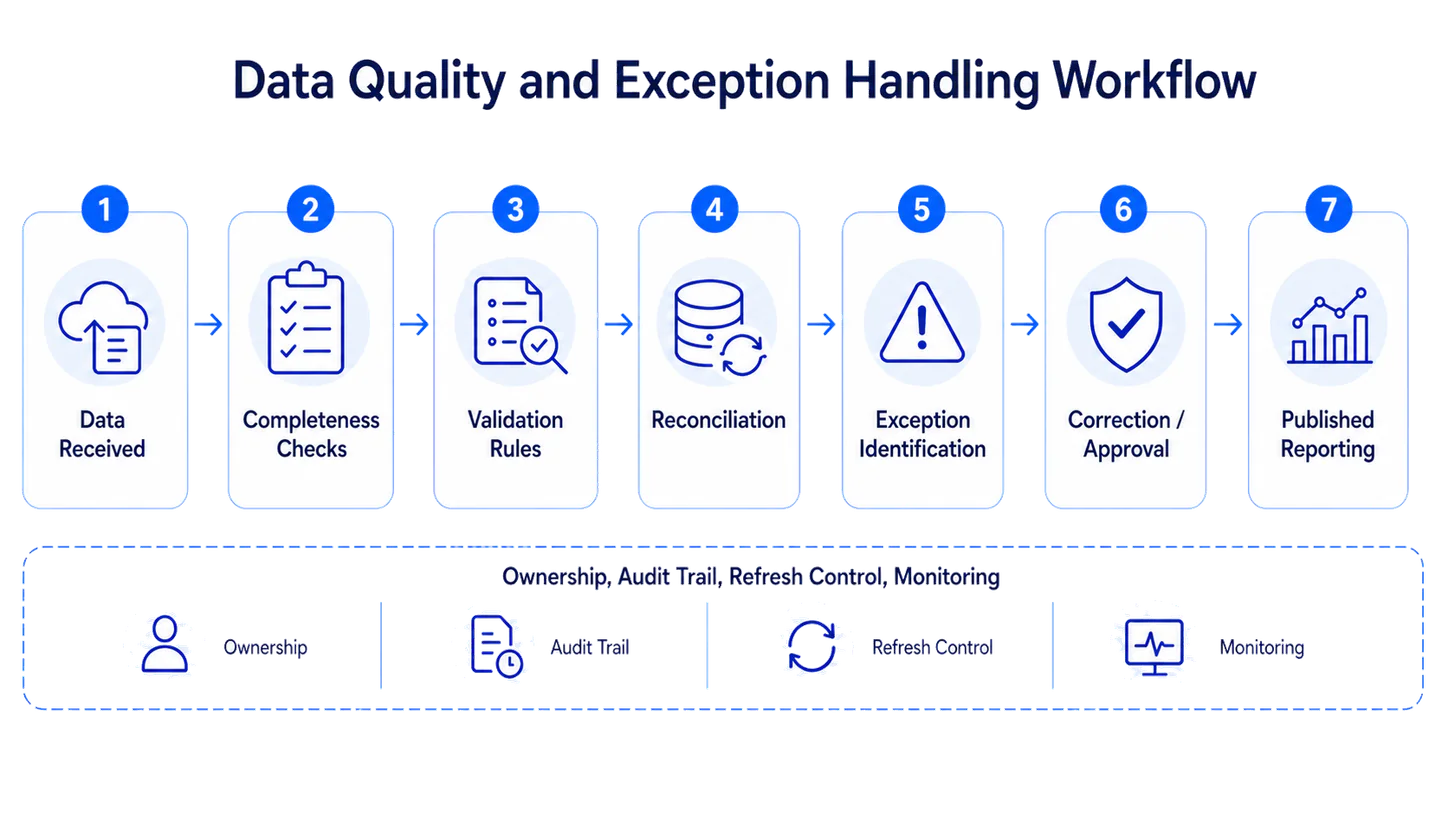
Better visuals do not fix weak data. The solution emphasized staging, validation, reconciliation, and exception handling so data quality issues were surfaced and resolved before publication.
This was critical for cross-source management questions, including target-versus-actual performance, inventory visibility and aging, margin analysis, and customer activity reporting.
A governed reporting layer reduced the risk of each report becoming a separate interpretation of the business and improved user trust and adoption.
Reporting and Decision Support
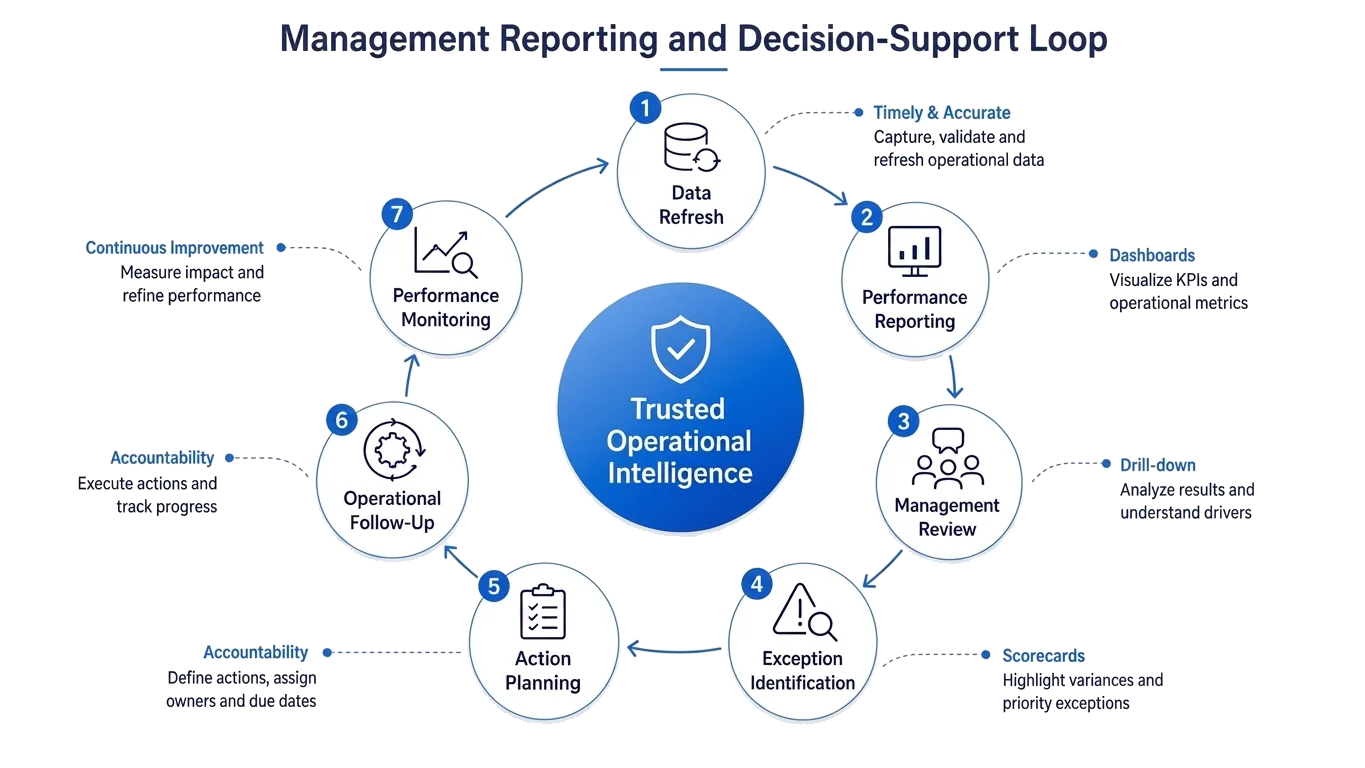
The reporting layer supported BI dashboards, operational scorecards, exception reports, and automated management outputs. It also enabled drill-down from summary views to operational detail.
This shifted manager time from assembling data toward identifying issues, understanding root causes, planning actions, and monitoring execution.
Operational intelligence differs from ordinary reporting by helping users understand not only what happened, but what needs attention next.
Business Value
Reporting
Reduced manual effort, improved KPI consistency across dashboards and scorecards.
Visibility
Exception identification faster, accountability stronger, coverage across all operational areas.
Security
Role-aware access, controlled distribution, protection of sensitive commercial data.
Future Ready
Practical foundation for recommendations, alerts, and AI-assisted decision support.
Future Opportunity
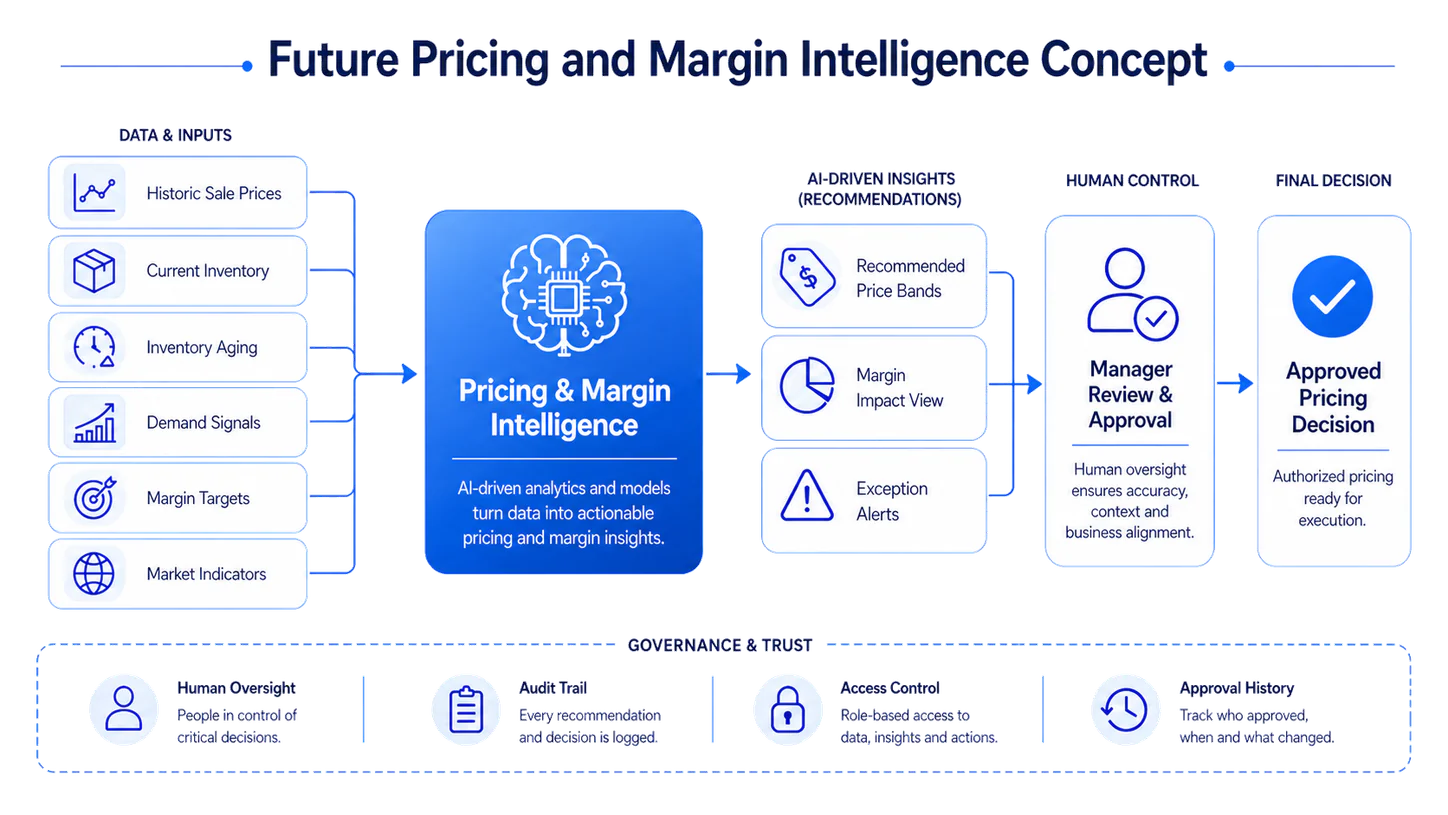
The same architecture can support advanced pricing and margin intelligence by combining historical sales, current stock, inventory aging, demand signals, margin targets, and market indicators.
Recommendations should support manager decisions, not replace them. Review, approval or rejection, and audit trails preserve control in commercially sensitive environments.
Why This Matters
They need secure data flows, governed access, reliable infrastructure, clear ownership, consistent business logic, and outputs users actually adopt.
For dealer groups and multi-location operators, this is especially important because leadership needs a broad view while local managers and departments need practical, role-relevant detail.
Proteance applies this founder-led experience to help organizations move from fragmented data and manual reporting toward trusted management intelligence that supports action.
Start with the decisions the business needs to make
Reporting should begin with business decisions, not dashboard layouts. The first question should be what leaders and managers need to understand, what actions they need to take, and what information supports those actions.
Define the numbers before visualizing them
A visually attractive report is not useful if KPI definitions are unclear. Measures such as margin, conversion, target achievement, inventory aging, activity completion, and operational throughput must be defined consistently.
Build governance into reporting from the beginning
Access control, credential handling, auditability, distribution rules, backup, and continuity should be designed from the start, not retrofitted after reporting is live.
Design access around real roles and responsibilities
Leadership, location managers, department heads, and operational users should not all receive the same data view by default. Access should reflect responsibility.
Treat data quality as an operational discipline
Validation, reconciliation, and exception handling are not purely technical tasks. They are part of maintaining trust in reporting and confidence in management decisions.
Make reporting useful enough that managers adopt it
Users move away from manual spreadsheets only when reporting is trusted, relevant, practical, and clearly connected to daily action.
Build for future automation without losing control
A strong data foundation can support future recommendations, alerts, and AI-assisted decisions, but governance, human oversight, and auditability remain essential.
This founder-led experience shows why secure automotive data integration is not simply a technology exercise. The real value comes from connecting fragmented sources, applying consistent business logic, protecting sensitive information, and supporting role-aware access to trusted intelligence.
Proteance helps automotive organizations move from disconnected reports toward secure, governed, and useful management intelligence for stronger accountability, performance improvement, and future decision support.
If your organization is dealing with fragmented reporting, inconsistent KPI logic, or uncontrolled data distribution, Proteance can help shape a governed model that fits how your business actually runs.
This case study reflects founder-led experience that now informs Proteance's approach. It is presented to illustrate relevant data integration, reporting, governance, and operational intelligence experience.