Data Exchange
The Trust Gap Behind AI Adoption: Why Operational Data Needs Governance Before Automation
AI adoption depends on trusted operational data. In fragmented industries, governance, validation, permissioning, lineage, and auditability need to come before automation.
Useful for: Executives, network operators, association leaders, platform owners, operations teams, data leads, and governance stakeholders
AI adoption is accelerating across Canadian business. Leaders are asking where AI can improve reporting, forecasting, productivity, service quality, pricing, compliance, and operational decision-making.
That interest is understandable. But there is a trust gap underneath many AI plans.
The issue is not only whether an AI tool can produce an answer. The issue is whether the business can trust the operational data behind that answer, explain where it came from, control who can use it, and defend the decision that follows.
For fragmented industries, this matters even more. Recyclers, equipment dealers, dealer groups, waste and recycling operators, collision networks, insurance broker networks, associations, and multi-site operators often work across many systems, locations, members, vendors, and reporting processes.
Data moves through local applications, spreadsheets, exports, portals, shared drives, emails, partner feeds, and manual submissions. In that environment, trust does not happen by accident. It has to be designed into the data layer before automation, analytics, benchmarking, partner sharing, or AI can be relied on.
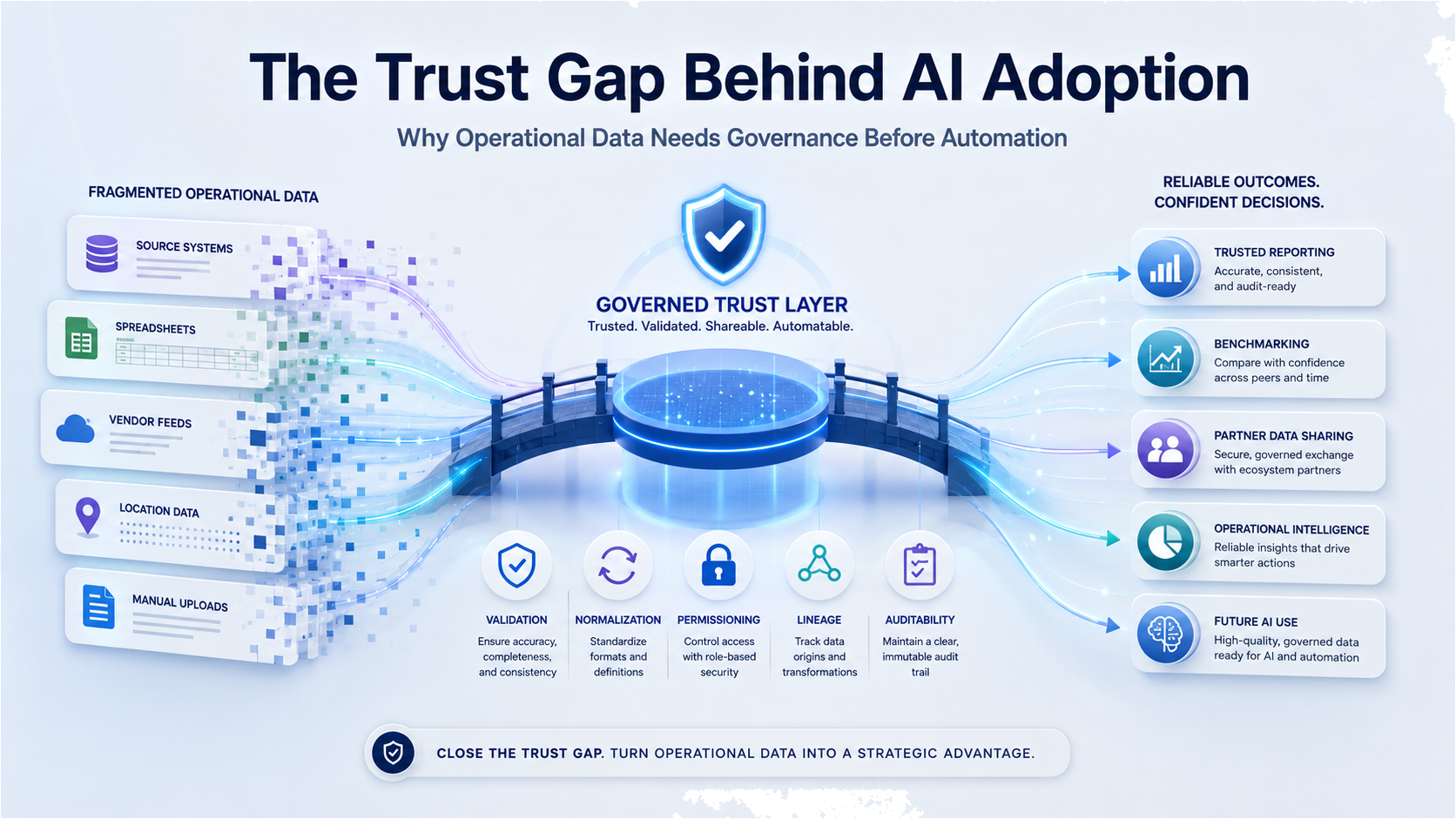
AI adoption is becoming a trust question
The AI conversation is changing. It is no longer only about experimentation. It is increasingly about business adoption, accountability, safety, privacy, sovereignty, and operational confidence.
That shift is important for Canadian organizations. AI may help businesses move faster, but it also raises practical questions about the data being used, whether that data is accurate enough for the decision, who approved its use, whether sensitive information was excluded, and whether the output can be explained and audited.
The trust gap starts before AI
Many organizations treat trust as a problem that appears after an AI system is introduced. In practice, the trust problem starts much earlier.
It starts when no one agrees which system is the source of truth. It starts when different locations use different definitions for the same metric. It starts when manual spreadsheets become part of the reporting chain. It starts when a vendor receives operational data without a clear access rule. It starts when a dashboard number cannot be traced back to the original record.
AI can expose these problems. It cannot automatically fix them.
Fragmented industries have more trust boundaries
In a single organization with one system and one operating model, data governance is still important. In fragmented industries, it becomes essential.
A fragmented operational network may include independent members, multiple locations, different software systems, different vendors, shared reporting requirements, partner data feeds, association-level benchmarks, head-office reporting, local operating teams, compliance reporting, and customer, supplier, or insurer-facing outputs.
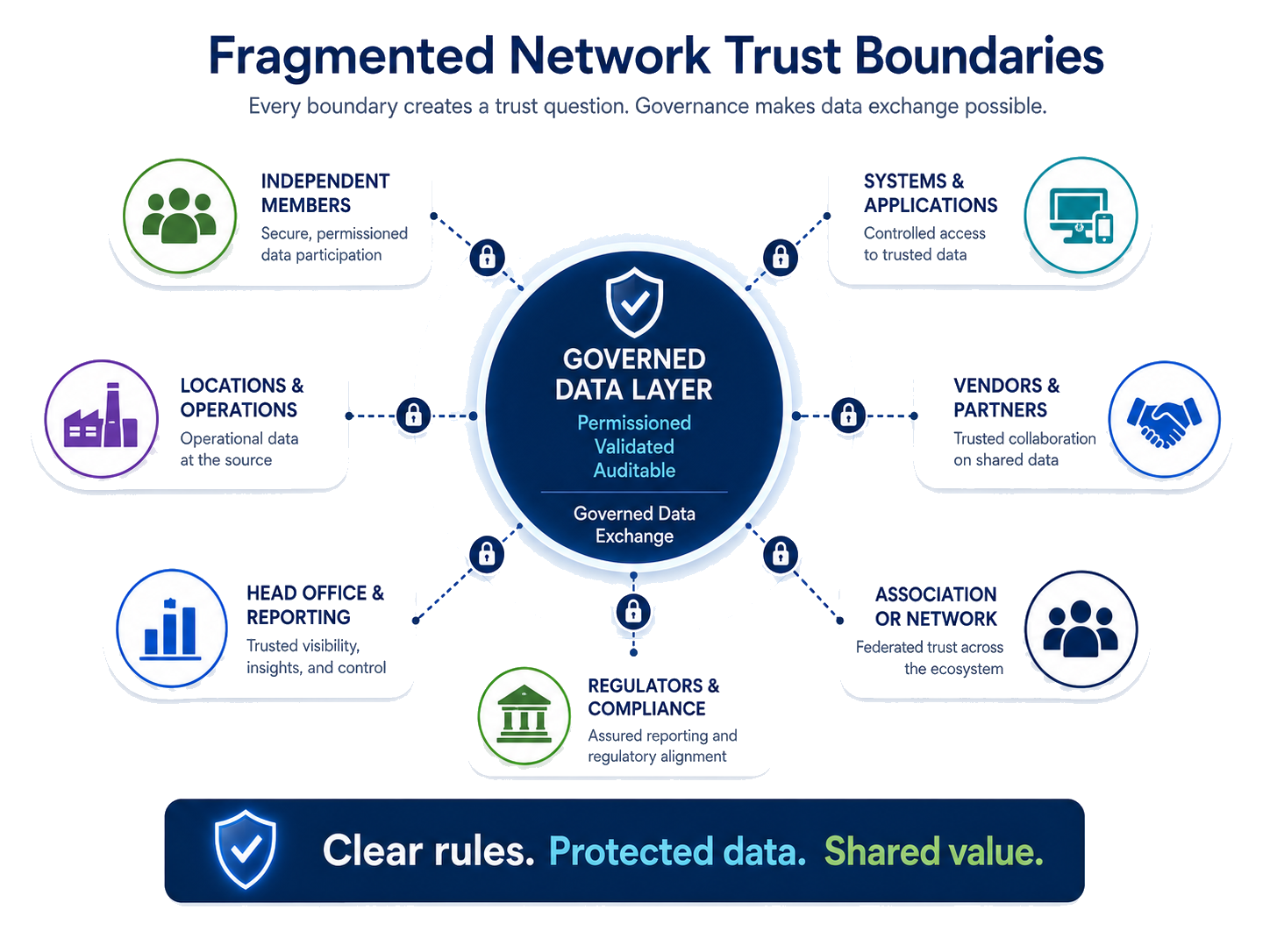
Should this data move? Should it be named, anonymized, or aggregated? Who is allowed to see it? Can it be used for benchmarking? Can it be sent to a partner? Can it inform an AI workflow? Can the contributor see what value came back?
Without clear governance, every new use case becomes a negotiation. Every report becomes harder to defend. Every automation introduces more risk.
What trust requires in the data layer
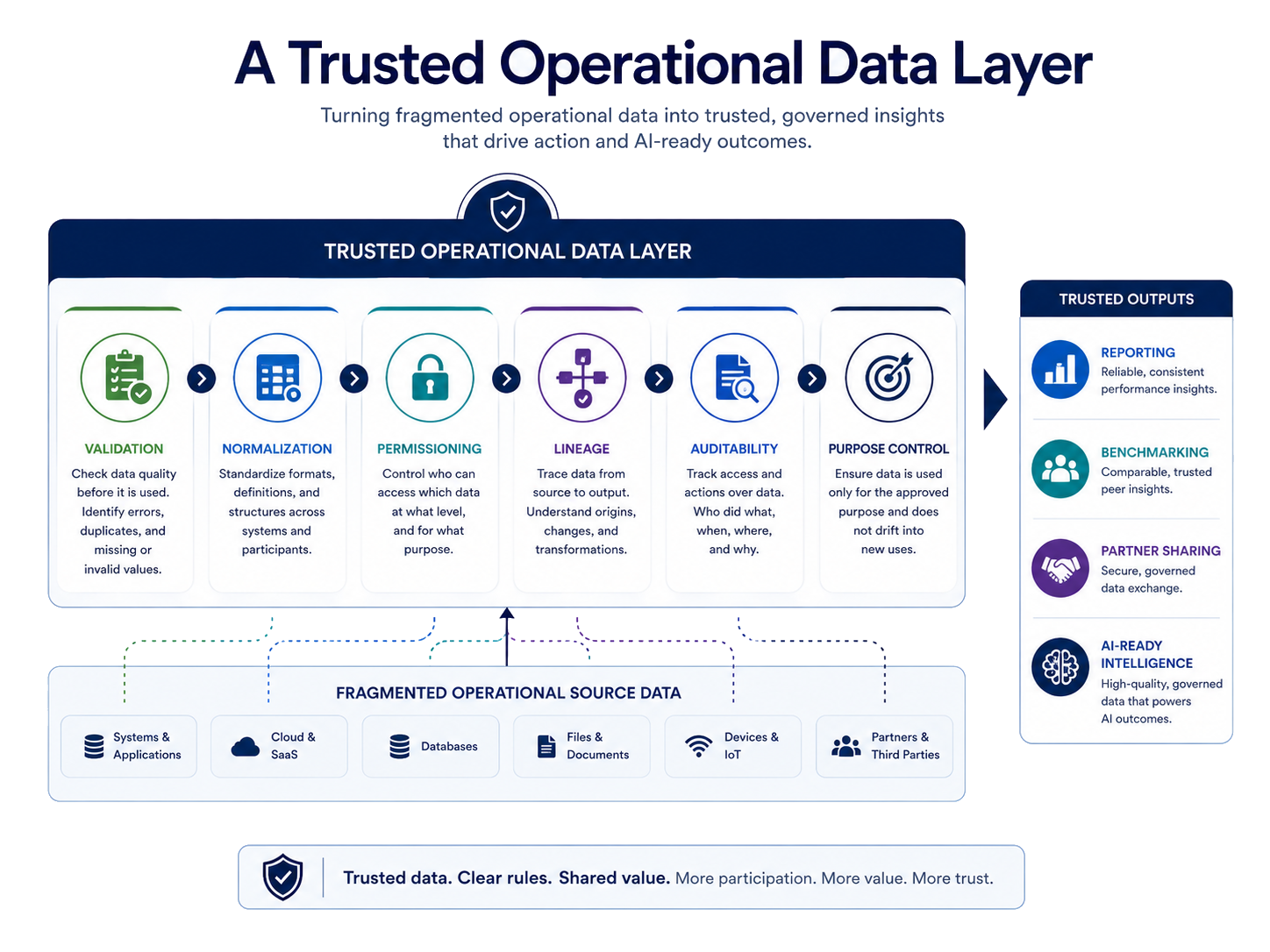
A trusted data layer needs more than storage and integration. It needs controls that make the data usable, explainable, and governable.
Validation
Data should be checked before it is used so missing fields, wrong formats, duplicate records, and conflicting statuses are caught early.
Normalization
Different systems often describe the same thing differently. A common operational model makes data comparable across locations, members, systems, and partners.
Permissioning
Access rules define who can see which data, at what level of detail, and for which purpose.
Lineage
Users need to understand where data came from and what transformations were applied before it reached a report or workflow.
Auditability
Access and movement should be traceable so teams can review who used what, when, and why.
Purpose control
Data collected for one use case should not drift into another without review.
Why AI makes governance more important
AI can increase the value of operational data. It can also increase the consequences of weak governance. A report may show a flawed number. An AI workflow may use that flawed number to classify, prioritize, recommend, route, or summarize.
That means the weakness can move from passive reporting into active decision support. The more a business wants AI to influence operational decisions, the more it needs to know that the underlying data is governed.
This is not an argument against AI. It is an argument for sequencing. Govern the data first. Automate carefully. Expand only when trust is earned.
Where Proteance fits
Proteance helps fragmented operational networks design the governance, permissioning, lineage, normalization, and validation needed for reliable reporting, benchmarking, partner feeds, and future AI use cases. This is practical data exchange and operational intelligence work, not generic AI positioning.
The Data Exchange Platform supports governed movement and approved sharing. The Operational Intelligence layer helps teams use trusted outputs in day-to-day operations. For a practical read on readiness, see Why Operational Data Quality Matters Before AI and AI Readiness Is Really Data Readiness.
The trust test before automation
- Do we know which source systems matter?
- Do we know which fields are reliable?
- Do different participants define the same fields differently?
- Can we trace key outputs back to source records?
- Do we have permission to use the data for the intended purpose?
- Can we separate named, anonymized, and aggregated views?
- Can participants see how their data creates value?
- Can access and movement be audited?
- Do we know which data should not be used?
- Have we started with a narrow use case that can be governed properly?
Trust is what turns data into a shared asset
Fragmented industries do not lack data. They lack a trusted way to combine it, govern it, and return useful intelligence from it. That is the real trust gap behind AI adoption.
AI may become part of the answer, but it should not be the foundation. The foundation is governed operational data: validated, normalized, permissioned, traceable, auditable, and connected to a clear business purpose.
When that foundation exists, AI becomes more useful. Reports become easier to trust. Benchmarks become easier to defend. Partner feeds become easier to control. Operational intelligence becomes more credible. Contributors become more willing to participate.
Can your operational data be trusted before it is automated?
Proteance helps fragmented networks design the governance, permissioning, lineage, and validation needed for reliable reporting, benchmarking, partner feeds, and future AI use cases.